
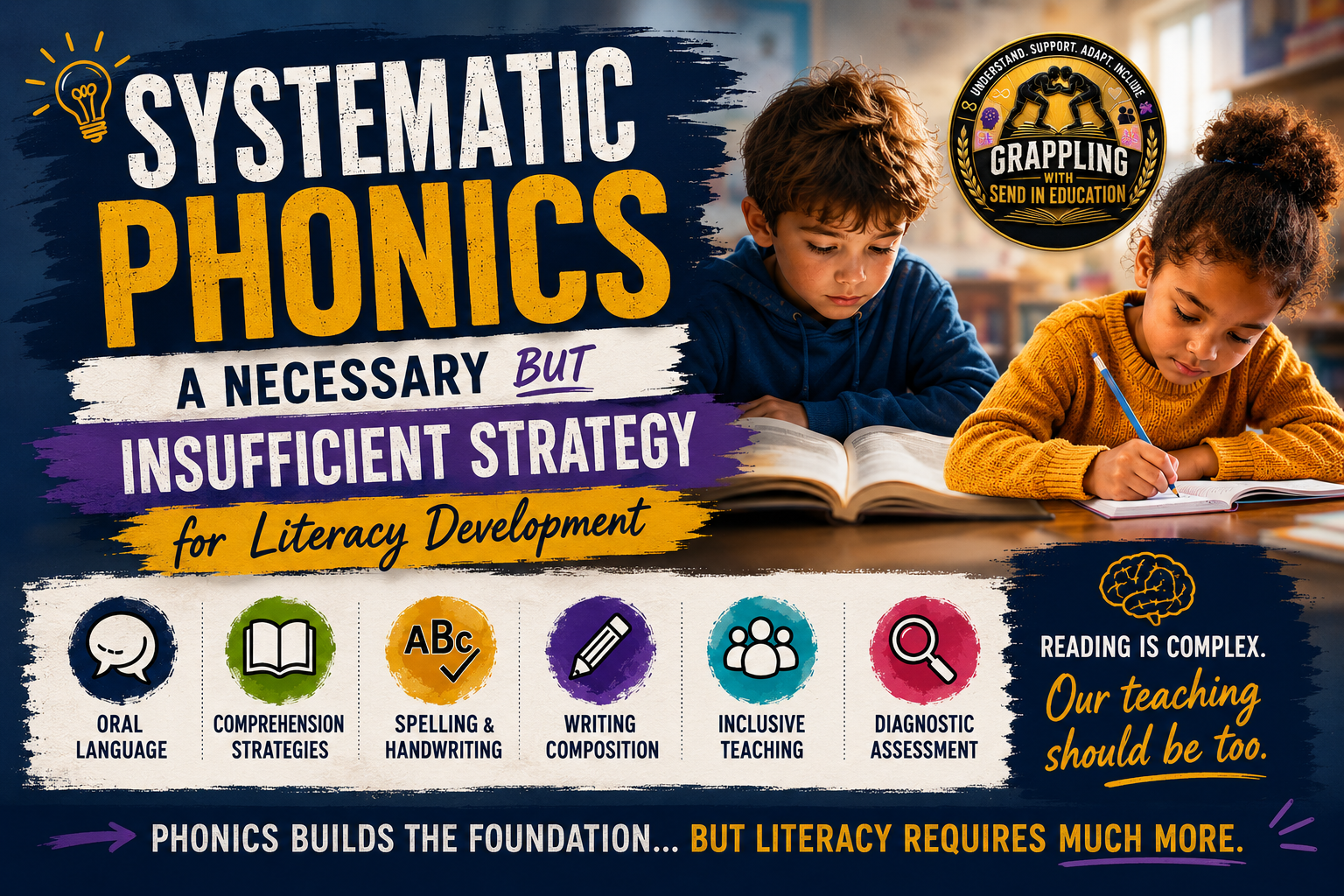
The introduction of systematic synthetic phonics (SSP) has become one of the most significant literacy policy developments within English education over the past two decades. In England, SSP forms a central component of the Department for Education’s Reading Framework and early literacy curriculum guidance, reflecting the government’s continued emphasis on explicit instruction in grapheme–phoneme correspondences and decoding skills (DfE, 2023). This approach has also been strongly influenced by international evidence, particularly the findings of the U.S. National Reading Panel, which concluded that systematic phonics instruction produces significant improvements in children’s word recognition, spelling, and reading achievement, particularly in the early years of schooling (National Reading Panel, 2000).
There is substantial evidence to suggest that SSP plays an important role in supporting beginning readers. Phonics instruction enables children to develop the alphabetic principle — the understanding that written letters and combinations of letters represent spoken sounds. Through structured and cumulative teaching, children learn to decode unfamiliar words, segment phonemes for spelling, and build automaticity in word recognition. Research demonstrates that children who receive high-quality phonics instruction in the early stages of literacy acquisition are more likely to experience reading success and are less likely to fall behind their peers (Ehri et al., 2001).
However, despite its importance, phonics alone cannot fully address the complexity of literacy development. Reading is not merely the mechanical act of decoding symbols on a page. Rather, it is a multifaceted cognitive, linguistic, and social process involving oral language, vocabulary knowledge, fluency, memory, inference, background knowledge, and comprehension monitoring (Snow, 2002). Consequently, there is growing recognition amongst researchers and educational organisations that while systematic phonics is necessary, it is insufficient when implemented in isolation.
The Education Endowment Foundation’s Improving Literacy in Key Stage 1 guidance report explicitly advocates for a balanced and integrated approach to literacy instruction (EEF, 2018). The report outlines eight evidence-informed recommendations designed to support broader literacy development:
- Developing pupils’ speaking and listening skills.
- Using a balanced and integrated approach to reading instruction.
- Effectively implementing systematic phonics programmes.
- Teaching reading comprehension strategies.
- Developing pupils’ transcription skills through spelling and handwriting instruction.
- Teaching sentence construction explicitly.
- Combining writing composition with oral rehearsal and planning.
- Using diagnostic assessment to inform teaching.
These recommendations collectively acknowledge that literacy development extends far beyond phoneme-grapheme correspondence. Oral language development, for example, is foundational to later reading comprehension. Children who possess stronger vocabulary knowledge and verbal reasoning skills are generally better equipped to understand texts, infer meaning, and engage critically with written language (Hulme & Snowling, 2016). For many pupils with Special Educational Needs and Disabilities (SEND), including autism spectrum condition (ASC), developmental language disorder (DLD), ADHD, and speech and language difficulties, oral language deficits can significantly impact reading comprehension even when decoding skills appear secure.
The Simple View of Reading, originally proposed by Gough and Tunmer (1986), remains highly influential in understanding this distinction. The model argues that reading comprehension is the product of two interdependent components: decoding ability and language comprehension. A child may be able to decode words accurately but still struggle to understand the meaning of a text if their oral language, vocabulary, or inferential thinking skills are underdeveloped. This explains why some pupils who perform adequately in phonics screening assessments continue to experience significant reading difficulties later in schooling.
Furthermore, an overemphasis on phonics can sometimes narrow literacy instruction in ways that disadvantage vulnerable learners. Research has shown that children benefit from rich language experiences, dialogic talk, storytelling, shared reading, and exposure to meaningful texts alongside explicit code-based instruction (Alexander, 2017). Literacy is not simply acquired through repetitive decoding drills but through active engagement with language, ideas, and communication. This is especially important for disadvantaged pupils and those with SEND, who may require more extensive opportunities for oral rehearsal, vocabulary enrichment, and scaffolded comprehension support.
Spelling also warrants greater attention within literacy discussions. Historically, spelling has often been treated as secondary to reading, despite evidence that spelling knowledge plays a crucial role in writing fluency, vocabulary acquisition, and orthographic understanding (Moats, 2005). Effective spelling instruction supports children in developing secure mental representations of words, enabling greater automaticity during writing tasks. When spelling is insecure, cognitive resources become overloaded during composition, reducing the pupil’s ability to focus on higher-order aspects of writing such as organisation, creativity, and sentence construction.
This issue is particularly significant for pupils with dyslexia and other literacy difficulties, who frequently experience persistent challenges with orthographic processing and working memory. Explicit spelling instruction that incorporates morphology, etymology, and pattern recognition can support these learners more effectively than phonics instruction alone (Bowers & Bowers, 2017). Morphological awareness — understanding prefixes, suffixes, and root words — also contributes significantly to vocabulary development and reading comprehension, particularly as pupils encounter increasingly complex academic texts in later schooling.
Similarly, handwriting and transcription skills remain essential yet often overlooked components of literacy development. Berninger et al. (2006) found that handwriting automaticity directly impacts writing quality because pupils who struggle with letter formation and transcription devote excessive cognitive effort to lower-level mechanical processes. The EEF therefore rightly highlights the importance of combining spelling, handwriting, and sentence construction within a cohesive literacy framework (EEF, 2018).
Another critical recommendation within the EEF guidance concerns diagnostic assessment. Effective literacy teaching requires continuous formative assessment to identify pupils’ specific barriers to reading and writing. Literacy difficulties are heterogeneous, meaning that two pupils who appear to struggle with reading may in fact require very different interventions. One child may have phonological deficits affecting decoding, while another may possess adequate decoding skills but severe oral language comprehension difficulties. Diagnostic assessment allows teachers to tailor interventions appropriately rather than relying on a one-size-fits-all phonics model.
This becomes especially relevant in the context of inclusive education and SEND provision. Many pupils with neurodivergent profiles require adaptive teaching approaches that integrate visual supports, multisensory learning, oral rehearsal, vocabulary pre-teaching, and reduced cognitive load strategies. While phonics can provide a valuable foundation, literacy interventions for SEND learners often need to address broader language-processing difficulties, executive functioning needs, and emotional barriers to learning (Snowling & Hulme, 2012).
Moreover, the social and motivational dimensions of reading must not be ignored. Children are more likely to become engaged readers when they encounter meaningful, enjoyable, and culturally relevant texts. Reading motivation, reading identity, and reading confidence are strongly associated with long-term literacy success (Clark & Teravainen-Goff, 2020). An exclusively skills-driven approach risks reducing reading to a mechanical exercise rather than fostering a lifelong engagement with literature and language.
In conclusion, systematic synthetic phonics represents an essential component of early literacy instruction and is strongly supported by educational research. It provides many children with the foundational decoding skills necessary for reading development and can significantly reduce early reading failure when implemented effectively. However, literacy is a far more complex process than decoding alone. Reading comprehension, oral language development, spelling, writing fluency, vocabulary acquisition, and motivation all play crucial roles in successful literacy development. As both the EEF and wider literacy research emphasise, effective literacy instruction must therefore adopt a balanced and integrated approach. Phonics should be viewed not as a complete solution, but as one important strand within a broader evidence-informed literacy framework designed to meet the diverse needs of all learners, particularly those with SEND and additional barriers to literacy acquisition.
References
- Alexander, R. (2017). Towards Dialogic Teaching: Rethinking Classroom Talk (5th ed.). Dialogos.
- Berninger, V., Abbott, R., Abbott, S., Graham, S., & Richards, T. (2006). Writing and reading connections between language by hand and language by eye. Journal of Learning Disabilities, 39(1), 39–56.
- Bowers, P. N., & Bowers, J. S. (2017). Beyond phonics: The case for teaching children the logic of the English spelling system. Educational Psychologist, 52(2), 124–141.
- Clark, C., & Teravainen-Goff, A. (2020). Children and Young People’s Reading Engagement in 2019. National Literacy Trust.
- Department for Education (DfE). (2020). Teacher Standards and Early Literacy Guidance. London: DfE.
- Department for Education (DfE). (2023). The Reading Framework: Teaching the Foundations of Literacy. London: DfE.
- Education Endowment Foundation (EEF). (2018). Improving Literacy in Key Stage 1. London: EEF.
- Ehri, L. C., Nunes, S. R., Stahl, S. A., & Willows, D. M. (2001). Systematic phonics instruction helps students learn to read: Evidence from the National Reading Panel’s meta-analysis. Review of Educational Research, 71(3), 393–447.
- Gough, P. B., & Tunmer, W. E. (1986). Decoding, reading, and reading disability. Remedial and Special Education, 7(1), 6–10.
- Hulme, C., & Snowling, M. J. (2016). Reading disorders and dyslexia. Current Opinion in Pediatrics, 28(6), 731–735.
- Moats, L. C. (2005). How spelling supports reading and why it is more regular and predictable than you may think. American Educator, 29(4), 12–22.
- National Reading Panel. (2000). Teaching Children to Read: An Evidence-Based Assessment of the Scientific Research Literature on Reading and Its Implications for Reading Instruction. National Institute of Child Health and Human Development.
- Snow, C. E. (2002). Reading for Understanding: Toward an R&D Program in Reading Comprehension. RAND Corporation.
- Snowling, M. J., & Hulme, C. (2012). Interventions for children’s language and literacy difficulties. International Journal of Language & Communication Disorders, 47(1), 27–34.


Leave a Reply