
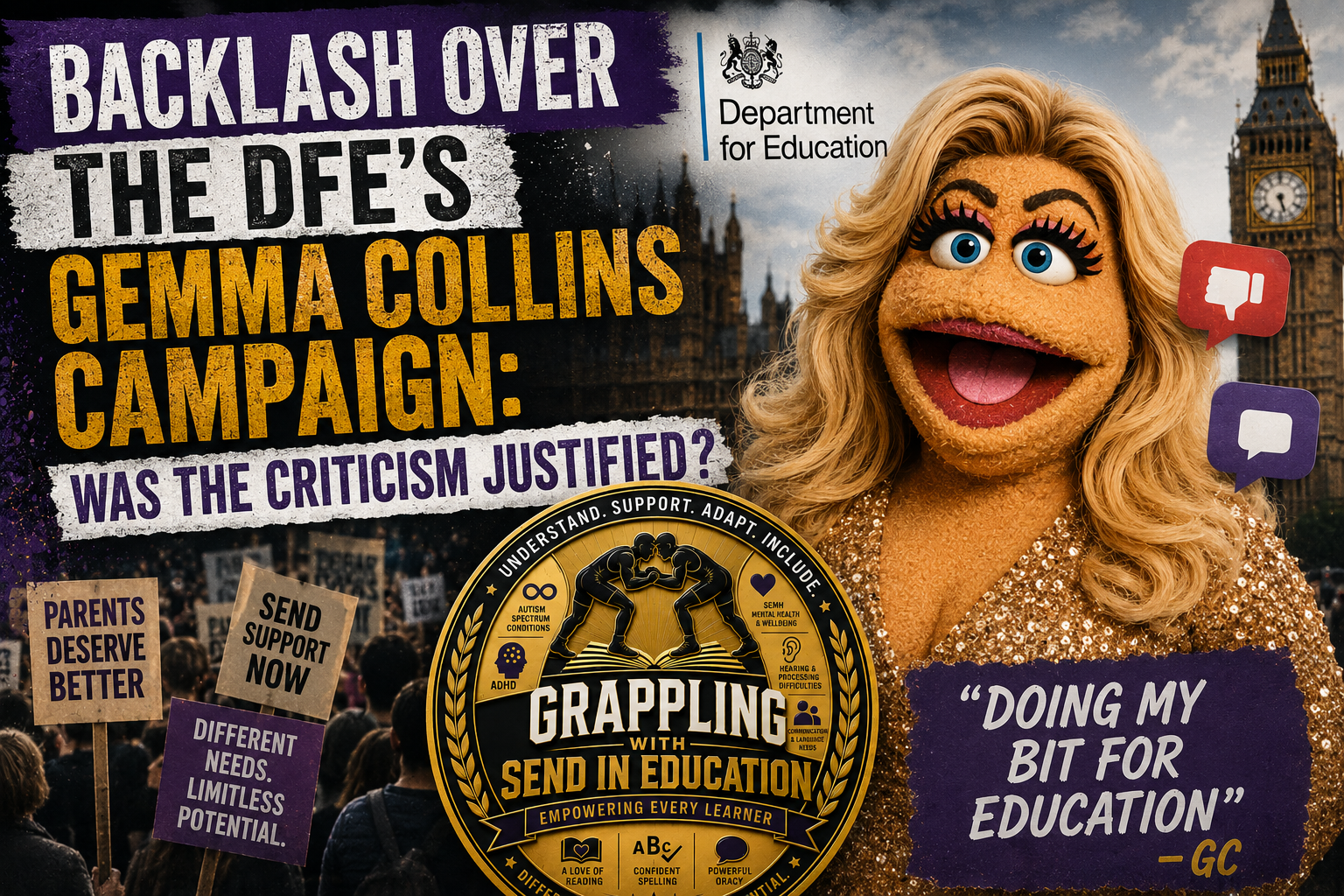
The backlash surrounding the Department for Education’s (DfE) collaboration with television personality Gemma Collins reveals growing tensions between modern government communication strategies and the emotional realities facing many families within England’s education system. While critics argued that the campaign was insensitive, particularly during an ongoing crisis in Special Educational Needs and Disabilities (SEND) provision, others defended the collaboration as a pragmatic attempt to engage audiences who are increasingly disconnected from traditional political messaging. Ultimately, the controversy demonstrates that the issue was not simply about Gemma Collins herself (perhaps using her as an unwilling puppet to get noticed – hence the article image), but about timing, public trust, and how educational policy is communicated during periods of heightened anxiety and dissatisfaction.
The DfE stated that the purpose of the campaign was to promote vocational education and inform young people about post-16 opportunities outside traditional university pathways (Department for Education, 2026a). This aligns with wider government reforms aimed at restructuring post-16 education through the introduction of V Levels and greater emphasis on technical and vocational qualifications (Department for Education, 2026b). From a communications perspective, using a high-profile media personality with a large social media following was a logical strategic decision. Collins possesses over two million Instagram followers, vastly exceeding the audience reach of either the DfE or Education Secretary Bridget Phillipson. Phillipson herself defended the collaboration by arguing that Collins could reach audiences “politicians can’t reach” (Holt, 2026).
In this sense, the campaign reflected broader trends in political communication. Governments increasingly rely on influencer culture, entertainment media, and personality-driven engagement to communicate policy messages to younger audiences who rarely consume traditional political content. Research into influencer marketing demonstrates that audiences often engage more positively with relatable public figures than with official institutional accounts (Abidin, 2018). The DfE therefore appears to have hoped that Collins’ celebrity appeal could normalise vocational education and challenge lingering social stigma surrounding non-university routes.
This is particularly important within the English education system, where vocational education has historically been viewed as inferior to academic pathways. Keep (2020) argues that England has long struggled with a cultural hierarchy that privileges university education over technical training, despite ongoing skills shortages and labour market demands. Collins herself, who did not follow a traditional academic pathway, may therefore have been selected intentionally to represent alternative routes to success. In this regard, the collaboration was not entirely superficial or meaningless. The DfE likely hoped to frame vocational pathways as aspirational, modern, and socially valuable.
However, while the strategic rationale may have had merit, the backlash was understandable because the campaign appeared disconnected from the wider emotional and political climate surrounding education in 2026. The controversy emerged immediately after consultation discussions regarding SEND reforms had concluded, at a time when many parents were expressing profound anger, exhaustion, and fear regarding support provision for their children (Holt, 2026). For many families navigating tribunal hearings, school placement disputes, and mental health crises linked to unmet SEND needs, the sudden appearance of celebrity-led social media content from the DfE felt inappropriate and insensitive.
The severity of frustration among SEND families is grounded in wider systemic problems. The National Audit Office (2024) concluded that England’s SEND system is financially unsustainable and failing to deliver consistent positive outcomes for children and young people. Similarly, the House of Commons Education Committee (2025) described the SEND system as adversarial, fragmented, and deeply stressful for parents. These findings reinforce why campaigners reacted so strongly to the DfE’s tone. The issue was not necessarily that Gemma Collins was involved, but that many families perceived the government to be prioritising social media image management over meaningful systemic reform.
This explains why critics such as SEND campaigner Aimee Bradley described the videos as “honestly sickening” and interpreted them as dismissive of the lived experiences of SEND families (Holt, 2026). Amy White similarly argued that the campaign demonstrated the government was not “reading the room” because the use of entertainment-style reels appeared disconnected from the daily realities experienced by families fighting for educational support (Holt, 2026). These reactions illustrate how public trust in educational institutions can be undermined when communication strategies appear emotionally misaligned with stakeholder experiences.
Nevertheless, some criticism of the campaign arguably moved beyond reasonable critique into forms of cultural snobbery. Phillipson argued that parts of the reaction were rooted in dismissive attitudes toward Collins herself and reflected elitist assumptions about who is considered suitable to speak about education (Holt, 2026). There is some validity to this argument. Celebrity figures associated with reality television are often framed as intellectually inferior within public discourse, despite their considerable influence and business success. Criticism that focused purely on Collins’ celebrity identity rather than the campaign’s strategic or ethical dimensions risks reinforcing class-based assumptions about legitimacy, intelligence, and educational value.
Dr Gillian Brooks of King’s College London offered perhaps the most balanced interpretation of the controversy. Brooks argued that the problem was not Collins personally, but rather the DfE’s inability to prevent her celebrity persona from overshadowing the policy message itself (Holt, 2026). This reflects wider communication research suggesting that influencer partnerships are most effective when the public figure complements rather than dominates institutional messaging (Freberg, Graham, McGaughey, & Freberg, 2011). In this case, the media discussion became overwhelmingly focused on Gemma Collins rather than vocational education reform. Consequently, the campaign generated visibility but arguably failed to generate clarity.
Despite this, it would be inaccurate to dismiss the campaign entirely as a meaningless publicity stunt. One of the campaign’s undeniable achievements was that it stimulated national discussion about education, vocational pathways, social mobility, and communication strategies. In an era where educational policy rarely attracts mainstream public attention outside moments of crisis, the campaign succeeded in generating widespread engagement. The problem is that public attention alone does not guarantee public confidence or trust.
Ultimately, the backlash against the DfE’s Gemma Collins campaign was partially justified. The criticism reflected genuine frustrations surrounding SEND provision, government priorities, and the emotional disconnect many families currently feel toward educational institutions. However, some reactions also revealed elements of cultural elitism and discomfort with celebrity-led communication strategies. The campaign was therefore more than a simple stunt; it was an attempt to modernise educational communication and broaden engagement with vocational education. Yet its execution demonstrated the risks of relying on entertainment culture during periods of significant public dissatisfaction. Educational communication requires not only visibility and reach, but also sensitivity, credibility, and an awareness of the wider social context in which policy messages are received.
References
- Abidin, C. (2018). Internet Celebrity: Understanding Fame Online. Bingley: Emerald Publishing.
- Department for Education. (2026a). New V levels and post-16 qualifications explained. London: DfE.
- Department for Education. (2026b). First V Levels subjects revealed as part of landmark reforms. London: DfE.
- Freberg, K., Graham, K., McGaughey, K., & Freberg, L. (2011). Who are the social media influencers? A study of public perceptions of personality. Public Relations Review, 37(1), 90–92.
- Holt, E. (2026). Backlash over Department for Education videos with Gemma Collins. BBC News, 20 May 2026.


Leave a Reply