
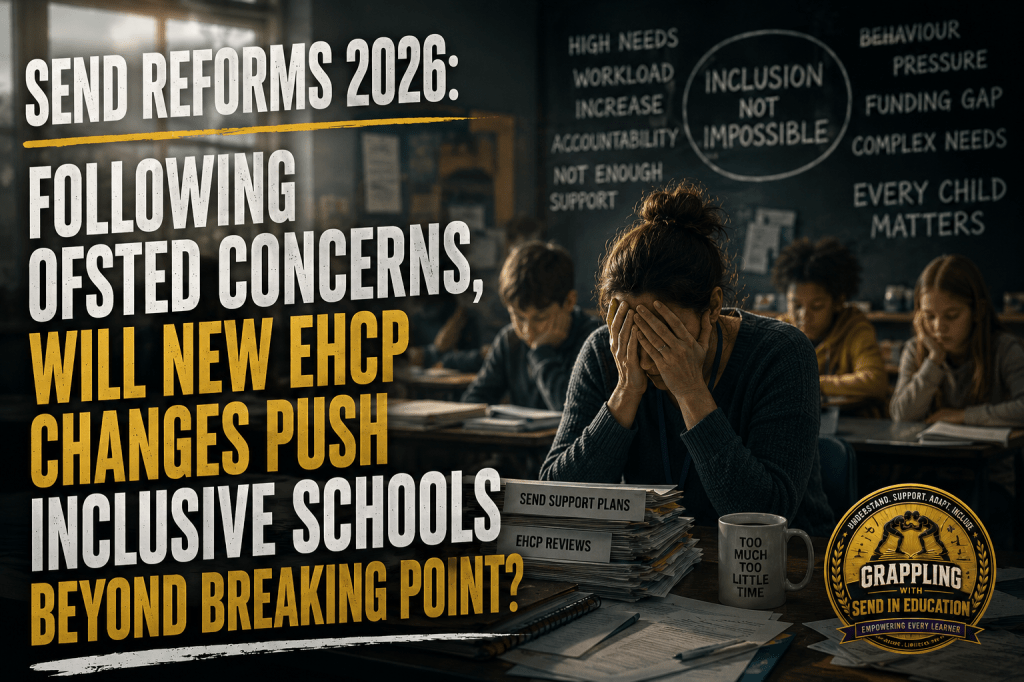
The recent debate surrounding SEND reform and Ofsted accountability continues to expose growing tensions within the English education system. In a previous discussion surrounding Ofsted’s approach to disadvantage and inclusion, concerns were raised about whether inspection frameworks unintentionally penalise schools that serve high numbers of vulnerable pupils, particularly those with Special Educational Needs and Disabilities (SEND). The latest article from Tes, Schools Could Face More Legal Disputes, SEND Experts Warn, builds upon these concerns by highlighting how the government’s proposed SEND reforms may intensify pressure on schools, teachers and families while simultaneously weakening legal protections for many SEND learners.
A key issue linking both articles is the contradiction between promoting inclusion and measuring school success primarily through accountability systems. The previous article argued that inclusive schools may already face disadvantages within Ofsted judgements when lower attainment reflects complex SEND profiles, deprivation, trauma, attendance barriers or literacy difficulties rather than poor teaching or leadership. The new reforms risk deepening this tension by shifting greater responsibility for SEND provision onto mainstream schools through the introduction of statutory Individual Support Plans (ISPs), while reducing parental access to SEND tribunals for many children (Roberts, 2026).
Under the proposed reforms, Education, Health and Care Plans (EHCPs) would remain only for pupils placed within the “specialist” tier, while many other SEND pupils would instead receive school-managed ISPs (Roberts, 2026). On the surface, this appears designed to streamline support and increase mainstream inclusion. However, concerns raised by Stone King, IPSEA and Speech and Language UK suggest that the reforms may create a system where schools are expected to deliver increasingly complex provision without corresponding legal clarity, funding or specialist capacity (Roberts, 2026). This mirrors earlier concerns regarding Ofsted’s accountability measures: schools are being encouraged to become more inclusive while simultaneously facing intensified scrutiny, workload and reputational risk.
For teachers and school leaders, the implications are considerable. The previous article highlighted that teachers in inclusive schools already face pressure to justify progress data, evidence intervention impact and demonstrate barrier removal for vulnerable pupils. The SEND reform proposals are likely to expand these pressures further. Schools would become responsible for creating, maintaining and annually reviewing ISPs, alongside delivering national inclusion standards and managing increasingly complex parental expectations. Margaret Mulholland of ASCL warned that without significant staffing, funding, preparation time and training, schools could be placed in an “impossible position” (Roberts, 2026).
This is particularly concerning because mainstream teachers are already navigating rising levels of SEND complexity within classrooms. The Education Endowment Foundation (EEF) argues that effective SEND provision depends upon adaptive teaching, scaffolding, explicit instruction, targeted intervention and strong relationships rather than bureaucratic accountability systems alone (EEF, 2025). However, when schools operate within high-stakes accountability environments, there is a danger that paperwork, compliance and defensive practice begin to overshadow meaningful inclusion. SENCOs, pastoral leaders and classroom teachers may increasingly find themselves acting as administrators and mediators rather than educators.
The reforms may also significantly affect relationships between schools and parents. The previous article identified concerns that schools serving disadvantaged communities could become trapped between accountability demands and the realities of supporting pupils with complex needs. The latest reforms risk intensifying this conflict because parents of children with ISPs would reportedly lose access to SEND tribunal appeals regarding the content and delivery of support (Roberts, 2026). IPSEA warned that parents may have “little recourse” if provision outlined within an ISP is not delivered appropriately (Roberts, 2026).
This creates a potentially adversarial environment in which schools become the visible face of systemic failure. Parents frustrated by inadequate support may increasingly resort to formal complaints, disability discrimination claims or judicial review. Stone King warned that disability discrimination claims against schools may rise under the new arrangements because schools themselves will carry greater responsibility for provision (Roberts, 2026). Yet many schools are already struggling with insufficient funding, shortages of educational psychologists, limited speech and language therapy access, CAMHS waiting lists and difficulties recruiting specialist staff. Consequently, schools may be blamed for failures that stem from wider structural problems across the SEND system.
For SEND pupils, the risks are profound. The previous article emphasised that inclusive education should involve far more than academic attainment, including communication development, attendance improvement, emotional wellbeing, curriculum accessibility and reduced exclusion risk. However, if SEND provision becomes less legally enforceable through ISPs, there is concern that support may become increasingly inconsistent between schools and local authorities. Pupils with autism, ADHD, dyslexia, SEMH needs and speech and language difficulties may be particularly vulnerable because their needs often fluctuate and require long-term specialist intervention.
Furthermore, there is a danger that schools under accountability pressure may unintentionally narrow SEND provision toward measurable outcomes rather than holistic development. As argued in the previous article, schools may prioritise attainment, attendance and data performance over inclusion, wellbeing and adaptive teaching when inspection outcomes dominate school reputation. The proposed reforms therefore risk creating a contradictory system where schools are encouraged to admit and support vulnerable learners while simultaneously operating within structures that may penalise them for doing so.
Nevertheless, the reforms also contain potentially positive elements. The government’s plans for inclusion bases in secondary schools, access to “experts at hand” services and new national inclusion standards suggest recognition that mainstream schools require stronger infrastructure to support SEND learners (Roberts, 2026). Similarly, Ofsted’s proposal to create a separate inclusion judgement indicates growing awareness that inclusion should not be hidden entirely within attainment data. However, these measures will only succeed if inclusion is genuinely prioritised through funding, specialist staffing, teacher training and accountability reform rather than symbolic policy language alone.
In conclusion, the new SEND reform proposals appear to deepen many of the concerns already raised regarding Ofsted, disadvantage and inclusion. Together, both articles reveal a system struggling to reconcile accountability with meaningful inclusive practice. Schools are increasingly expected to support more complex SEND needs within mainstream settings while simultaneously facing intense scrutiny over outcomes, attendance and performance data. Without substantial investment, legal clarity and robust support systems, there is a serious risk that teachers, parents and SEND learners will experience increased conflict, stress and inequality. Ultimately, meaningful SEND reform cannot simply redistribute responsibility onto schools; it must create a genuinely collaborative system where inclusion is supported, protected and properly resourced.
References
- Department for Education. (2023). SEND and Alternative Provision Improvement Plan. GOV.UK.
- Education Endowment Foundation (EEF). (2025). Special Educational Needs in Mainstream Schools.
- Ofsted. (2025). Ofsted confirms changes to education inspection and unveils new-look report cards. GOV.UK.
- Roberts, J. (2026). “Schools Could Face More Legal Disputes, SEND Experts Warn.” Tes Magazine. Available at: Tes Magazine
- Speech and Language UK. (2026). Consultation Response to SEND Reform Proposals.
- Stone King. (2026). Consultation Response on SEND Reforms.
- The Guardian. (2026). “‘Attainment at all costs’ approach could undermine SEND changes, school leaders in England say.”


 Grappling with SEND in Education
Leave a comment