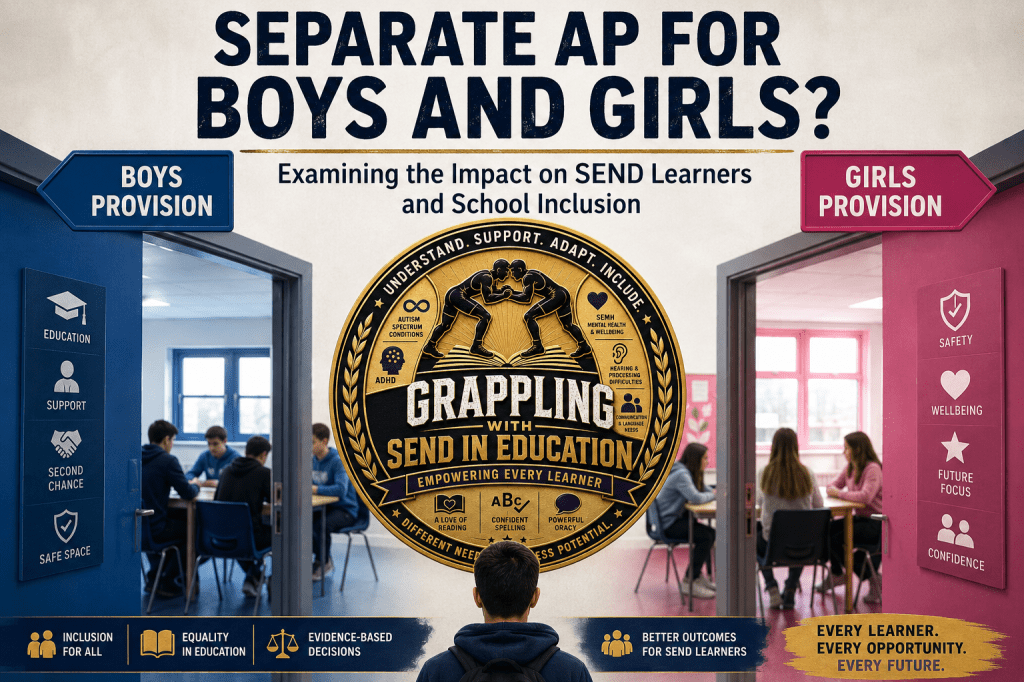
The TES article discussing Laura Trott and her proposal for separate alternative provision (AP) settings for boys and girls raises significant and complex questions regarding inclusion, safeguarding, educational equity, and the effectiveness of support systems for vulnerable learners. While the article identifies genuine weaknesses within the current AP system in England, including inconsistent quality, unregistered providers, and insufficient strategic oversight, the suggestion of gender-segregated provision requires careful critical analysis, particularly in relation to students with Special Educational Needs and Disabilities (SEND).
At its core, the article highlights longstanding concerns surrounding the fragmented nature of alternative provision. Research consistently demonstrates that AP settings in England often vary significantly in quality, curriculum breadth, safeguarding standards, and reintegration opportunities (DfE, 2023). Trott’s assertion that the current system is “patchy” reflects wider criticism from organisations such as Ofsted and the Children’s Commissioner for England, both of which have warned that vulnerable children can become marginalised within poorly regulated AP systems. Many pupils attending AP have overlapping SEND needs, including autism spectrum condition (ASC), ADHD, speech and language difficulties, SEMH needs, trauma histories, and undiagnosed learning difficulties (Gill et al., 2017). Consequently, the discussion cannot be reduced simply to behaviour management or gender differences; rather, it must be understood through the broader lens of unmet SEND need and systemic educational exclusion.
One positive aspect of Trott’s comments is the increased political attention being given to AP. Historically, AP has often been viewed as a peripheral part of the education system rather than an integral safeguarding and inclusion service. The acknowledgement that AP requires reform could encourage greater investment, improved accountability, and stronger national standards. This is particularly important because many SEND students placed in AP report feelings of rejection, stigma, and educational failure following exclusion from mainstream education (Thomson & Pennacchia, 2016). Improved oversight of AP providers, especially unregistered settings, could strengthen safeguarding and ensure that vulnerable learners receive consistent educational and therapeutic support.
Furthermore, Trott’s concerns regarding girls’ attendance and experiences in AP settings raise valid safeguarding issues. Research suggests that girls in AP are often under-identified because female presentations of distress can differ significantly from boys. Girls with autism, ADHD, trauma, anxiety, or masking behaviours may go unnoticed until crises emerge (Lai et al., 2015). Additionally, girls placed in predominantly male AP environments may experience heightened vulnerability, intimidation, or feelings of isolation, particularly where there are histories of violence, exploitation, or trauma. In this context, the proposal for specialist provision designed specifically around girls’ social, emotional, and therapeutic needs may offer benefits for some learners.
However, the article also raises substantial concerns regarding segregation and the potential unintended consequences for SEND learners. The proposal for separate provision for boys and girls risks oversimplifying the causes of behavioural difficulties and exclusion. Many behaviours associated with AP referrals stem not from gender itself, but from unmet SEND needs, adverse childhood experiences (ACEs), poverty, mental health difficulties, or failures within mainstream schooling systems (Timpson Review, 2019). Creating gender-segregated AP settings may therefore fail to address the root causes of exclusion and could instead reinforce stereotypes about boys as inherently disruptive or girls as inherently vulnerable.
This concern is particularly significant for neurodivergent students. SEND learners often benefit from inclusive, relational, and socially diverse environments that develop communication, empathy, and collaborative skills. Over-segregation can increase feelings of “otherness” and social marginalisation. Inclusive education theory argues that separation should only occur where absolutely necessary and where it demonstrably improves outcomes for learners (Florian & Black-Hawkins, 2011). If poorly implemented, gender-separated AP risks creating environments focused more on containment than meaningful educational rehabilitation.
Additionally, the proposal does not fully account for the experiences of transgender or non-binary young people, many of whom already experience disproportionately high levels of exclusion, mental health difficulties, and bullying within education systems (Stonewall, 2017). A rigid gender-segregated approach may inadvertently create further barriers for these vulnerable students unless carefully planned with inclusive safeguarding policies.
Another major issue raised indirectly within the article is the overrepresentation of SEND students in AP and exclusion pathways. Research shows that children with SEND are significantly more likely to be excluded than their peers, particularly those with SEMH needs, autism, ADHD, and communication difficulties (DfE, 2022). This suggests systemic weaknesses within mainstream education rather than solely problems within AP itself. Many schools continue to struggle with adaptive teaching, early intervention, funding pressures, and access to specialist support services. As a result, AP often functions as a reactive solution after educational breakdown has already occurred.
Trott’s suggestion that multi-academy trusts (MATs) should have AP attached to them presents both opportunities and risks. On one hand, this could improve accountability by preventing schools from distancing themselves from excluded learners. It may encourage trusts to invest more heavily in early intervention, inclusion strategies, literacy support, therapeutic approaches, and adaptive teaching. On the other hand, there is a risk that embedded AP units could normalise internal exclusion systems unless accompanied by strong inclusion policies and external oversight.
The article also correctly highlights concerns regarding unregistered AP providers. Lord Storey’s description of this issue as a “national disgrace” reflects growing anxiety surrounding safeguarding failures and inconsistent educational quality. Unregistered provision can leave SEND learners especially vulnerable because these settings may lack trained SEND specialists, therapeutic staff, or robust safeguarding procedures. For children with communication difficulties or trauma backgrounds, such environments can significantly increase educational and emotional risk.
Ultimately, the article demonstrates that reform of alternative provision is urgently needed, but meaningful reform must move beyond simplistic structural solutions. Gender-specific provision may benefit some learners, particularly girls with trauma histories or safeguarding concerns, but it should not become a blanket approach. Instead, AP reform should prioritise individualised, trauma-informed, and SEND-responsive practice.
Several key recommendations emerge from this discussion:
- Greater Early Intervention in Mainstream Schools
Many SEND learners enter AP because their needs were not identified or supported early enough. Increased funding for speech and language support, educational psychologists, literacy interventions, SEMH provision, and adaptive teaching could reduce exclusion rates significantly. - National Standards for AP
Clear national standards should regulate curriculum quality, safeguarding, therapeutic support, reintegration pathways, and SEND provision across all AP settings, including unregistered providers. - Trauma-Informed and SEND-Specific Training
All AP staff should receive specialist training in autism, ADHD, trauma, attachment difficulties, communication needs, and de-escalation approaches. - Flexible Provision Rather Than Blanket Segregation
Rather than entirely separate systems for boys and girls, AP settings should offer flexible specialist pathways tailored to individual learner needs, including therapeutic groups, mentoring, and targeted safeguarding support. - Stronger Reintegration Pathways
AP should not become a long-term endpoint for SEND learners. Greater collaboration between mainstream schools and AP settings is required to support reintegration wherever appropriate. - Improved Student Voice
SEND learners themselves should be consulted about their experiences of AP. Too often policy discussions occur without the perspectives of the young people directly affected.
In conclusion, the article raises important concerns about the weaknesses within England’s alternative provision system and rightly draws attention to inconsistencies in quality and safeguarding. However, while gender-specific AP may offer targeted benefits for certain vulnerable learners, particularly girls experiencing trauma or safeguarding risks, it also carries the danger of reinforcing exclusionary practices and failing to address the deeper structural causes of educational disengagement among SEND students. Sustainable reform requires a holistic approach centred on inclusion, early intervention, trauma-informed practice, and personalised support. Without addressing the systemic failures within mainstream education that contribute to exclusion in the first place, changes to AP alone are unlikely to significantly improve long-term outcomes for SEND learners.
References
- Department for Education (2022). Permanent and Fixed Period Exclusions in England.
- Department for Education (2023). Alternative Provision Statistics and SEND Review.
- Florian, L., & Black-Hawkins, K. (2011). Exploring Inclusive Pedagogy. British Educational Research Journal.
- Gill, K., Quilter-Pinner, H., & Swift, D. (2017). Making the Difference: Breaking the Link Between School Exclusion and Social Exclusion. Institute for Public Policy Research.
- Lai, M. C., Lombardo, M. V., & Baron-Cohen, S. (2015). Autism in Girls and Women. Nature Reviews Neurology.
- Stonewall (2017). School Report: The Experiences of LGBT Young People in Britain’s Schools.
- Thomson, P., & Pennacchia, J. (2016). What’s the Alternative? Effective Support for Young People Disengaging from the Mainstream. Institute of Education Press.
- Timpson, E. (2019). Timpson Review of School Exclusion. Department for Education.
 Grappling with SEND in Education
Leave a comment