
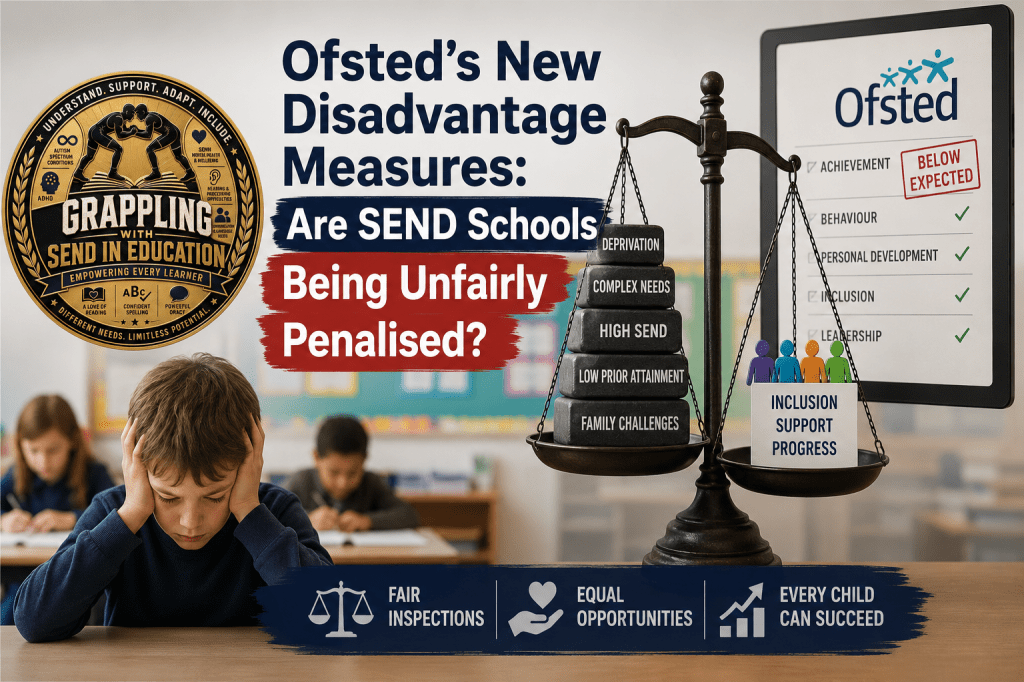
The recent TES article reports that Ofsted will clarify how its inspection toolkits judge disadvantaged pupils’ achievement, after data showed schools with above-average FSM intakes were more likely to fall below the “expected standard” for achievement. It also raises a crucial SEND concern: whether inspection systems reward genuinely inclusive schools or unintentionally penalise them when lower average attainment reflects higher levels of need, deprivation, language barriers, trauma, or complex SEND profiles.
A central issue is validity. Ofsted argues that context is “baked into” achievement judgements and that FSM pupils are compared with FSM pupils nationally. However, the article also states that there is not yet a specific tool to compare schools with similar SEND, FSM and contextual profiles. This matters because SEND is not a single, uniform category. A school with high numbers of pupils with autism, SEMH needs, speech and language difficulties, dyslexia, ADHD, EHCPs or significant literacy gaps may be doing highly effective inclusive work while still producing attainment data below national averages. Without precise contextual comparison, inspection risks confusing lower outcomes caused by structural disadvantage with weaker provision.
For SEND students, the potential impact is significant. If achievement remains the most vulnerable inspection category, schools may feel pressure to prioritise measurable academic outcomes over broader inclusion, wellbeing, communication, independence and social development. This could narrow the curriculum for SEND learners, increase intervention withdrawal, and encourage “teaching to the test” rather than adaptive teaching. This is in tension with Ofsted’s own stated focus on inclusion and SEND in the new report-card model. Ofsted announced that inspections would specifically focus on provision for disadvantaged pupils, pupils with SEND and children known to social care, through a separate inclusion grade.
For teachers, the article highlights a workload and accountability problem. Teachers working in inclusive schools may face intensified pressure to evidence progress, justify outcomes and prove that barriers are being removed. This can be productive if it leads to better assessment, targeted intervention and professional development. However, it can also create defensive practice, excessive data production and anxiety, particularly for SENCOs, English teachers, pastoral teams and teaching assistants supporting pupils with complex needs. The EEF guidance stresses that effective SEND provision depends on high-quality teaching, positive relationships, explicit instruction, scaffolding and careful use of targeted interventions, not simply accountability pressure.
The most positive element in the article is Ofsted’s recognition that inclusion must be judged separately. Inclusion should not be hidden inside attainment data because inclusive practice involves identifying needs early, adapting teaching, supporting access to curriculum, developing communication, improving attendance, reducing exclusion risk and working with families. The DfE’s SEND and Alternative Provision Improvement Plan similarly emphasises a system where children and young people with SEND receive the right support in the right place at the right time.
However, the danger is that an inclusion grade becomes symbolic if achievement grades continue to dominate school reputation. A school could be highly inclusive but still publicly marked down for achievement. This creates a policy contradiction: schools are encouraged to admit, retain and support vulnerable learners, yet may be judged harshly when those learners’ outcomes reflect wider inequality. Recent reporting shows school leaders remain concerned that an “attainment at all costs” approach could undermine SEND reform by creating perverse incentives against inclusion.
Conclusion
The article reveals a necessary but incomplete shift in inspection policy. Clarifying “disadvantage-to-disadvantage” comparisons is helpful, but it does not fully solve the problem for SEND pupils or teachers. A fair system must compare schools with genuinely similar profiles, including SEND complexity, EHCP levels, mobility, attendance, deprivation, prior attainment and language background. Otherwise, inclusive schools risk being penalised for serving the pupils who most need them.
Recommendations
Ofsted and the DfE should ensure that the new similar-schools model includes robust SEND indicators, not just FSM data. Inspection should value progress, adaptive teaching, curriculum access, communication development, attendance improvement, reduced exclusions and pupil voice. Schools should not be rewarded only for high attainment, but for demonstrable impact on learners who face the greatest barriers.
References
Department for Education. (2023). SEND and alternative provision improvement plan. GOV.UK.
Education Endowment Foundation. (2025). Special Educational Needs in Mainstream Schools.
Ofsted. (2025). Ofsted confirms changes to education inspection and unveils new-look report cards. GOV.UK.
Roberts, J. (2026). Ofsted will update toolkits to ‘clarify’ approach to disadvantage. Tes.
The Guardian. (2026). ‘Attainment at all costs’ approach could undermine SEND changes, school leaders in England say.



 Grappling with SEND in Education
Leave a comment