
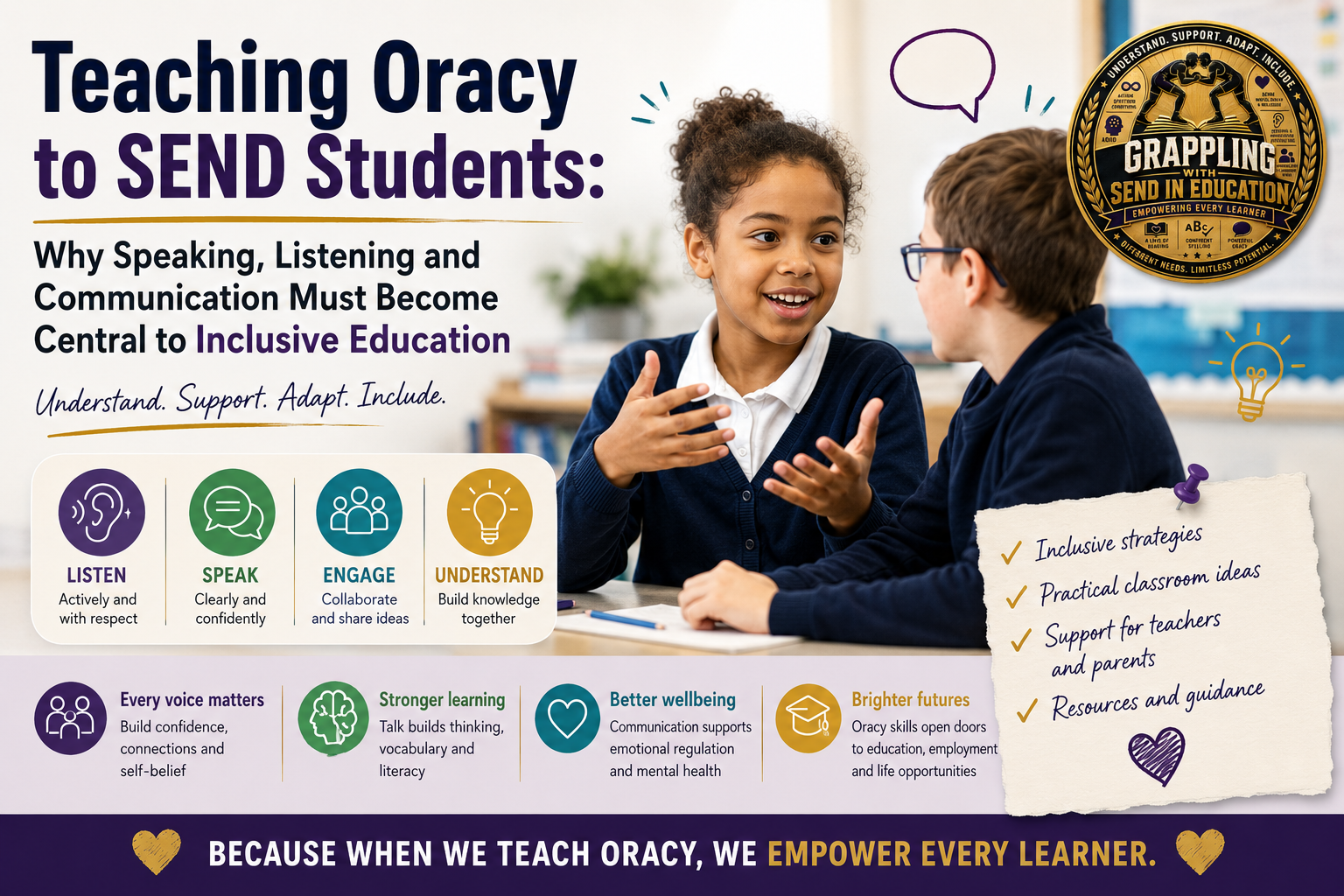
In recent years, increasing attention has been given to the importance of oracy within education. Concerns regarding children’s declining communication skills, increased social anxiety, widening educational inequality, and rising levels of speech and language difficulties have led many educationalists to argue that spoken language development must become a far greater priority within schools. The publication of the Independent Commission on the Future of Oracy Education in England report We Need to Talk further intensified these discussions by arguing that oracy should be considered the “fourth R” alongside reading, writing and arithmetic.
The Commission defined oracy as the ability to articulate ideas, develop understanding, and engage with others through speaking, listening and communication. This definition reflects a growing recognition that spoken language is not simply an additional skill within education but rather a fundamental component of learning itself. Before pupils can successfully read, write, reason, debate or problem solve, they must first be able to process spoken language, organise thoughts and communicate ideas effectively.
For pupils with Special Educational Needs and Disabilities (SEND), the significance of oracy is even more substantial. Many SEND learners experience barriers relating to speech, language, communication, processing, emotional regulation or social interaction. Without carefully structured opportunities to develop communication skills, these pupils are at increased risk of academic underachievement, social isolation, anxiety, behavioural difficulties and exclusion from meaningful participation in school life.
Despite this, oracy frequently remains underdeveloped within educational practice. Many schools continue to prioritise written outcomes and examination performance while spoken language development receives comparatively limited explicit teaching. This is problematic because literacy itself is deeply dependent upon language development. Weak oral language skills can significantly impair reading comprehension, vocabulary acquisition, writing organisation and wider academic attainment.
This article explores the importance of teaching oracy to SEND students, examines why schools must prioritise communication development more effectively, analyses approaches to teaching oracy within primary and secondary settings, and offers evidence-informed strategies for teachers and parents seeking to support inclusive communication development.
What Is Oracy?
The term “oracy” was first introduced by Andrew Wilkinson in the 1960s. Wilkinson argued that spoken language deserved equal status alongside literacy and numeracy within the curriculum because communication underpins educational participation and social development. While literacy focuses upon reading and writing, oracy refers to the ability to communicate effectively through speaking and listening.
Modern interpretations of oracy extend far beyond simple verbal fluency. Effective oracy includes:
- The ability to articulate ideas clearly
- Active listening and response
- Collaborative discussion
- Verbal reasoning
- Audience awareness
- Emotional regulation during interaction
- Appropriate use of vocabulary and grammar
- Persuasive communication
- Social communication skills
- Interpretation of tone, gesture and facial expression
Voice 21 and the Cambridge Oracy Centre developed the widely used Oracy Framework, which categorises oracy into four interconnected strands:
Physical Strand
This includes the physical aspects of communication such as:
- Voice projection
- Clarity of speech
- Pace and fluency
- Eye contact
- Gesture
- Facial expression
- Body language
Many SEND pupils, particularly those with speech disorders, autism or anxiety-related conditions, may experience challenges within this area.
Linguistic Strand
This strand relates to:
- Vocabulary knowledge
- Sentence structure
- Grammatical accuracy
- Subject-specific language
- Verbal precision
- Adaptation of language to audience and context
Pupils with Developmental Language Disorder (DLD), dyslexia or speech and language needs may struggle significantly within this area.
Cognitive Strand
This involves:
- Organising ideas verbally
- Reasoning
- Clarifying understanding
- Summarising
- Building arguments
- Asking questions
- Reflective thinking
Communication is therefore not simply expressive but deeply connected to cognition and learning.
Social and Emotional Strand
This includes:
- Turn-taking
- Collaboration
- Empathy
- Listening respectfully
- Confidence
- Self-regulation
- Responding appropriately in conversation
This strand is particularly significant for pupils with autism spectrum conditions, ADHD and social communication difficulties.
Together, these strands demonstrate that oracy is a complex and multidimensional process that intersects with academic achievement, emotional wellbeing and social participation.
Why Oracy Is Critically Important for SEND Students
Speech and Language as Foundations of Learning
One of the most significant misconceptions within education is the belief that speaking and listening are secondary skills compared with reading and writing. In reality, spoken language forms the foundation upon which literacy and wider learning are built.
Before pupils can:
- Understand written texts
- Produce organised writing
- Participate in discussions
- Follow instructions
- Demonstrate reasoning
- Solve problems
- Engage critically with ideas
they must first possess sufficient oral language skills.
Research from the Education Endowment Foundation (EEF) consistently demonstrates that oral language interventions can significantly improve attainment, particularly in literacy and reading comprehension. The EEF Teaching and Learning Toolkit identifies oral language interventions as among the most effective educational approaches, capable of producing approximately six months of additional progress.
For SEND pupils, difficulties with speech and language frequently create barriers across multiple areas of learning. Weak oral language skills may affect:
- Reading comprehension
- Vocabulary acquisition
- Writing organisation
- Working memory
- Listening comprehension
- Emotional expression
- Peer relationships
- Behaviour regulation
- Classroom participation
Pupils who cannot effectively understand or communicate ideas often experience frustration and disengagement, which may later manifest as behavioural difficulties or withdrawal from learning.
Oracy, SEND and Literacy Development
The relationship between spoken language and literacy development is particularly important when considering SEND learners.
Many educational systems heavily emphasise phonics and decoding skills, especially during early education. While systematic phonics is undoubtedly valuable, it is insufficient on its own for many SEND pupils. Reading comprehension depends not only upon decoding ability but also upon vocabulary knowledge, background understanding, narrative structure and language comprehension.
Children who struggle to:
- Understand complex sentences
- Retell narratives
- Process vocabulary
- Explain ideas verbally
are likely to struggle with reading comprehension and written expression even if they can decode words accurately.
This is especially relevant for pupils with:
- Developmental Language Disorder
- Autism Spectrum Condition
- ADHD
- Dyslexia
- Speech and language impairments
- Hearing impairments
For these learners, explicit oral language teaching is essential.
Approaches such as:
- Vocabulary instruction
- Structured discussion
- Verbal rehearsal
- Storytelling
- Dialogic teaching
- Collaborative learning
can significantly improve both communication and literacy outcomes.
Oracy and Emotional Wellbeing
Communication difficulties are strongly linked to emotional wellbeing.
Children who struggle to express thoughts, emotions or needs may experience:
- Anxiety
- Isolation
- Frustration
- Low self-esteem
- Emotional dysregulation
- Behavioural difficulties
Research consistently demonstrates that many behavioural incidents within schools have communication difficulties at their core. Pupils who cannot articulate confusion, discomfort or distress may instead communicate through:
- Refusal
- Withdrawal
- Aggression
- Avoidance
- Emotional outbursts
This is particularly relevant for SEND students who may already experience heightened anxiety and social vulnerability.
Teaching oracy can therefore support emotional regulation by enabling pupils to:
- Explain emotions
- Ask for help
- Clarify misunderstandings
- Resolve disagreements
- Build relationships
- Develop self-advocacy skills
For autistic pupils especially, structured support around communication and social interaction can significantly improve confidence and reduce social anxiety.
Why Schools Need to Prioritise Oracy More Effectively
Despite increasing recognition of its importance, oracy often remains marginalised within schools.
Several factors contribute to this issue.
Accountability Pressures
Schools are heavily judged through examination outcomes and written attainment measures. As a result, communication development may be perceived as less important because it is less formally assessed.
However, this creates a significant contradiction. Schools often expect pupils to produce sophisticated written responses despite weak underlying language skills.
Limited Teacher Training
Many teachers receive limited training regarding:
- Speech and language development
- Communication disorders
- Social communication difficulties
- Language scaffolding
- Oracy pedagogy
Consequently, communication difficulties may be misunderstood as:
- Poor behaviour
- Defiance
- Lack of effort
- Low ability
rather than unmet communication needs.
Rising Communication Difficulties
Schools increasingly report significant rises in speech, language and communication difficulties among children entering education.
Possible contributing factors include:
- Increased screen time
- Reduced face-to-face interaction
- Social deprivation
- COVID-19 disruption
- Reduced early language exposure
The Communication Trust has repeatedly identified speech, language and communication needs as among the most prevalent childhood difficulties within schools.
Teaching Oracy in Primary Schools
The Importance of Early Intervention
Primary education is the most critical stage for communication development because early language skills strongly predict later academic attainment.
Early intervention is particularly important for SEND pupils because communication difficulties often widen over time if left unsupported.
Young children develop language through:
- Play
- Storytelling
- Conversation
- Social interaction
- Repetition
- Modelling
For many SEND pupils, however, these skills require explicit teaching rather than implicit acquisition.
Effective Oracy Strategies in Primary Schools
Communication-Rich Classrooms
Primary classrooms should intentionally prioritise talk.
Teachers can support this by:
- Modelling vocabulary
- Narrating thinking processes
- Encouraging collaborative discussion
- Using visual supports
- Displaying sentence stems
- Celebrating pupil contributions
A communication-rich classroom creates opportunities for repeated language exposure and meaningful interaction.
Structured Discussion Activities
Many SEND pupils struggle with unstructured conversation. Structured discussion activities therefore provide essential support.
Examples include:
- Think-pair-share
- Circle time
- Talking partners
- Role play
- Story retelling
- Collaborative games
- Barrier activities
Sentence stems can significantly scaffold communication:
- “I agree because…”
- “I think this means…”
- “Can you explain…?”
- “My opinion is…”
Visual and Alternative Communication Supports
Visual supports are highly effective for many SEND learners.
These may include:
- Visual timetables
- Widgit symbols
- Communication boards
- AAC devices
- Makaton signing
- Emotion cards
- Graphic organisers
Such supports reduce cognitive load and improve participation.
Teaching Oracy in Secondary Schools
Challenges Within Secondary Education
Secondary schools often present greater barriers to communication development due to:
- Examination pressure
- Larger class sizes
- Subject compartmentalisation
- Time constraints
- Increased adolescent anxiety
SEND pupils can become progressively quieter and less engaged if communication needs are not addressed.
Some students stop participating entirely because they fear embarrassment or failure.
Effective Secondary Oracy Strategies
Explicit Discussion Teaching
Secondary pupils should not be expected to automatically know how to:
- Debate respectfully
- Build arguments
- Challenge ideas appropriately
- Clarify understanding
- Ask productive questions
These skills require modelling and guided practice.
Reducing Communication Anxiety
Many SEND pupils experience severe anxiety surrounding speaking.
Helpful strategies include:
- Rehearsal opportunities
- Pair discussion before whole-class discussion
- Small-group presentations
- Recorded presentations
- Cue cards
- Visual prompts
Confidence develops gradually through positive experiences.
Using Oracy to Support Literacy
Verbal rehearsal can significantly improve writing quality for SEND learners.
Effective strategies include:
- Verbal planning before writing
- Group discussion tasks
- Podcast activities
- Oral summaries
- Talk for Writing approaches
Speaking allows pupils to organise ideas cognitively before transferring them into written form.
Advice for Teachers
Teachers play a central role in communication development.
Important strategies include:
- Understanding pupils’ communication profiles
- Allowing additional processing time
- Modelling rich language
- Using structured discussion routines
- Valuing all forms of communication
- Praising communication attempts
Importantly, teachers must recognise that communication may be:
- Spoken
- Signed
- Symbol-based
- Gesture-supported
- Technology-assisted
Inclusive classrooms validate all communication methods equally.
Advice for Parents
Parents are equally important in supporting communication development.
Helpful approaches include:
- Talking regularly with children
- Reading aloud together
- Discussing emotions openly
- Encouraging storytelling
- Playing language-based games
- Reducing communication pressure
- Allowing processing time
Children often communicate most confidently when discussing topics linked to personal interests. Parents can therefore use special interests as opportunities to develop vocabulary, conversation and confidence.
Conclusion
Oracy is not an optional educational extra. It is fundamental to learning, literacy, inclusion, wellbeing and future participation in society.
For SEND students especially, communication development can determine whether they feel:
- Included or isolated
- Confident or anxious
- Heard or misunderstood
- Empowered or marginalised
Schools cannot continue prioritising written attainment while neglecting the spoken language skills that underpin educational success.
Effective oracy teaching requires:
- Explicit communication instruction
- Structured opportunities for talk
- Inclusive communication approaches
- Teacher modelling
- Collaboration between school and home
Primary schools must establish strong communication foundations early, while secondary schools must continue developing confidence, reasoning, discussion and self-advocacy throughout adolescence.
Most importantly, educational systems must recognise that every child deserves the opportunity to communicate, contribute and be heard.
References
Education Endowment Foundation (2021). Teaching and Learning Toolkit: Oral Language Interventions.
Independent Commission on the Future of Oracy Education in England (2024). We Need to Talk.
NACE (2016). Employers Rate Verbal Communication as Most Important Candidate Skill.
Voice 21. The Oracy Framework.
Wilkinson, A. (1965). The Concept of Oracy. Educational Review, 17(4), 11–15.
The Communication Trust. Available at: https://www.thecommunicationtrust.org.uk
ICAN. Available at: https://ican.org.uk
Useful Organisations and Resources
Voice 21: https://voice21.org
Education Endowment Foundation: https://educationendowmentfoundation.org.uk
ICAN: https://ican.org.uk
The Communication Trust: https://www.thecommunicationtrust.org.uk
Twinkl Oracy Hub: https://www.twinkl.co.uk


Leave a Reply