
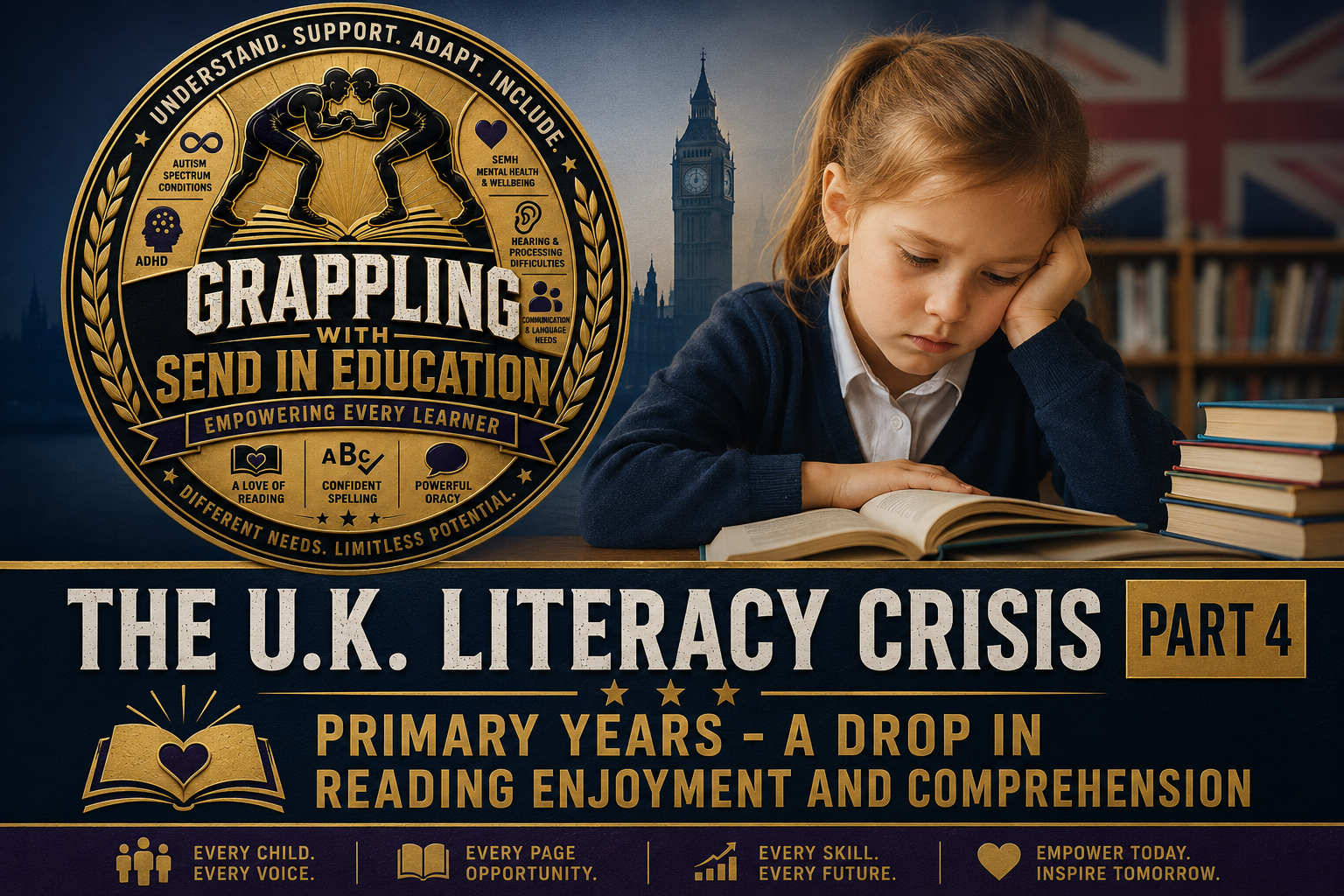
The early years of literacy instruction in England have undergone significant transformation over the past two decades. The introduction of systematic synthetic phonics has led to substantial improvements in children’s ability to decode text, with successive cohorts demonstrating stronger early word-reading skills than previous generations (Department for Education, 2023). However, the development of literacy extends far beyond decoding. Reading is a complex process that requires children to move from recognising words accurately to understanding, interpreting, analysing and enjoying what they read. Increasingly, evidence suggests that while many children leave Key Stage 1 able to decode successfully, a substantial number struggle to make the transition towards fluent, motivated and comprehending readers.
Research from BookTrust (2024) highlights a concerning trend: children’s enjoyment of reading begins to decline during the primary years and continues to fall as they progress through school. This reduction in reading motivation has significant implications because reading enjoyment is strongly associated with reading attainment, vocabulary growth, comprehension development and future academic success (Clark & Teravainen-Goff, 2020). Children who enjoy reading tend to read more frequently, encounter a wider range of vocabulary and develop stronger comprehension skills. Conversely, children who disengage from reading often experience a slowing of literacy development, creating a widening gap between themselves and their peers.
The challenge facing primary education is therefore not simply teaching children how to read but helping them become readers who choose to read, understand what they read and can use reading as a tool for learning across the curriculum.
From Decoding to Reading Comprehension
The Simple View of Reading, which underpins much literacy policy in England, proposes that reading comprehension is the product of two essential components: word recognition and language comprehension (Gough & Tunmer, 1986).
Children may become proficient decoders through phonics instruction but still struggle with comprehension if they lack:
- Vocabulary knowledge.
- Background knowledge.
- Oral language skills.
- Inferential reasoning abilities.
- Reading fluency.
In the early stages of reading development, considerable cognitive effort is devoted to decoding individual words. As decoding becomes increasingly automatic, cognitive resources can be redirected towards understanding the meaning of the text (LaBerge & Samuels, 1974).
This shift is crucial. Children who fail to achieve fluency often remain trapped in a cycle of laborious reading where so much attention is devoted to word recognition that little capacity remains for comprehension. As a result, reading becomes difficult, tiring and less enjoyable.
This relationship between fluency and motivation is often overlooked. Children who read effortlessly generally experience greater success, which reinforces positive attitudes towards reading. Children who struggle with fluency frequently encounter frustration, reduced confidence and declining engagement.
The Decline in Reading Enjoyment
BookTrust’s 2024 survey of children’s reading habits found that reading enjoyment declines steadily across the primary years. Younger children often view reading as a pleasurable shared activity involving stories, parents and classroom discussion. However, as children progress through school, reading increasingly becomes associated with assessment, comprehension exercises and academic performance.
Several factors contribute to this decline:
Reduced Reading Choice
As curriculum demands increase, opportunities for children to select books based on personal interests may decrease. Research consistently demonstrates that autonomy and choice are key drivers of reading motivation (Guthrie & Wigfield, 2000).
Increased Academic Pressure
Primary pupils increasingly encounter reading through the lens of assessment. Comprehension tasks, SATs preparation and structured questioning can unintentionally transform reading from a pleasurable activity into a performance task.
Digital Competition
Children today have access to a vast array of digital entertainment. Social media, video platforms, gaming and streaming services compete directly with reading for children’s leisure time (Twenge, 2018).
Reading Difficulty
Pupils who experience challenges with fluency, vocabulary or comprehension often avoid reading because it becomes associated with failure. This creates a vicious cycle whereby less reading leads to fewer opportunities for improvement.
The implications are profound. Reading enjoyment has been shown to predict educational outcomes more strongly than parental socioeconomic status in some studies (Sullivan & Brown, 2015). Children who read frequently for pleasure develop broader vocabularies, stronger general knowledge and greater academic resilience.
Reading Fluency: The Missing Link
One of the most significant developments in literacy research over the past decade has been renewed attention to reading fluency.
Fluency encompasses three interconnected elements:
- Accuracy.
- Automaticity.
- Prosody (expression and phrasing).
Fluent readers read accurately, quickly and with appropriate expression. This allows them to focus on constructing meaning rather than decoding individual words (Rasinski, 2012).
The Education Endowment Foundation (EEF) identifies fluency as a critical but often neglected component of literacy instruction (EEF, 2021). While phonics programmes frequently receive substantial instructional time, structured fluency teaching is less common despite its strong evidence base.
Effective fluency practices include:
- Repeated reading.
- Echo reading.
- Choral reading.
- Modelled reading.
- Paired reading.
- Performance reading.
These approaches help pupils develop automatic word recognition while simultaneously supporting comprehension.
Importantly, fluency serves as a bridge between decoding and understanding. Without fluency, many pupils remain technically capable readers who nevertheless struggle to comprehend increasingly complex texts.
The EEF’s Seven Recommendations for Key Stage 2 Literacy
Recognising these challenges, the Education Endowment Foundation’s Improving Literacy in Key Stage 2 guidance report (2018) outlines seven evidence-informed recommendations designed to sustain literacy development throughout primary education.
1. Develop Pupils’ Reading Fluency
Supported reading practice helps pupils transition from accurate decoding to automatic and expressive reading.
Teachers can:
- Model fluent reading.
- Use repeated reading activities.
- Provide guided oral reading opportunities.
- Encourage performance-based reading.
Fluent readers comprehend more effectively because less cognitive effort is devoted to word recognition.
2. Teach Reading Comprehension Strategies
Strong readers actively engage with texts.
Effective comprehension instruction teaches pupils how to:
- Predict.
- Summarise.
- Clarify misunderstandings.
- Question the text.
- Make inferences.
These strategies improve pupils’ ability to construct meaning independently and become more metacognitive readers.
3. Develop Vocabulary Through Explicit and Implicit Instruction
Vocabulary knowledge is one of the strongest predictors of reading comprehension (Nation, 2013).
Effective vocabulary instruction involves:
- Direct teaching of new words.
- Rich classroom discussion.
- Exposure to sophisticated texts.
- Morphological instruction.
- Multiple encounters with target vocabulary.
Children cannot comprehend what they do not understand linguistically. Therefore, vocabulary instruction is fundamental rather than supplementary.
4. Teach Spelling and Handwriting Explicitly
Historically, spelling has often been viewed as secondary to reading. However, research increasingly demonstrates that spelling and reading are mutually reinforcing processes (Ehri, 2014).
Spelling instruction helps children:
- Develop orthographic knowledge.
- Recognise spelling patterns.
- Improve decoding accuracy.
- Strengthen word recognition.
Similarly, fluent handwriting reduces cognitive load during writing tasks, allowing pupils to focus on content and composition.
5. Teach Writing Composition Strategies
Effective writers do not simply write; they employ deliberate strategies.
Instruction should include:
- Planning techniques.
- Organisational structures.
- Sentence construction.
- Revision processes.
- Audience awareness.
Teaching these explicitly improves both writing quality and confidence.
6. Teach Pupils to Plan, Monitor and Evaluate Their Writing
Self-regulation is a critical aspect of literacy development.
Skilled writers continuously:
- Review their work.
- Monitor progress.
- Adapt strategies.
- Evaluate effectiveness.
Developing these metacognitive skills promotes independence and long-term writing success.
7. Use Targeted Interventions for Struggling Pupils
Not all children respond equally to universal classroom instruction.
Evidence suggests that struggling readers benefit from interventions that are:
- Timely.
- Structured.
- Evidence-based.
- Delivered by trained staff.
- Closely monitored.
Effective interventions focus on identified needs rather than generic literacy support.
The Crucial Role of Spelling
One area often neglected in literacy discussions is spelling. Yet spelling plays a central role in both reading and writing development.
According to Ehri’s (2014) theory of orthographic mapping, spelling helps children establish permanent connections between sounds, letters and meanings. Through repeated exposure and practice, words become stored in long-term memory and recognised automatically.
This process supports:
Reading
Children who understand spelling patterns decode unfamiliar words more efficiently.
Writing
Automatic spelling reduces cognitive load, allowing pupils to focus on generating ideas rather than recalling letter sequences.
Vocabulary Growth
Knowledge of prefixes, suffixes and roots supports understanding of unfamiliar vocabulary.
Reading Fluency
Words stored through orthographic mapping can be recognised instantly, supporting fluent reading.
Far from being an isolated skill, spelling sits at the intersection of reading, writing and vocabulary development.
Building a Literacy-Rich Primary Environment
To counter declining reading enjoyment, schools must create environments where literacy is valued, visible and meaningful.
Effective approaches include:
Reading for Pleasure Programmes
Creating dedicated opportunities for:
- Independent reading.
- Shared reading.
- Book talk.
- Author studies.
Diverse and Inclusive Texts
Ensuring pupils encounter books that reflect:
- Their identities.
- Their interests.
- Different cultures and perspectives.
Family Engagement
Parental involvement remains one of the strongest predictors of reading success (Sénéchal & LeFevre, 2014).
Schools can support families through:
- Reading workshops.
- Home reading guidance.
- Book lending schemes.
- Reading challenges.
Cross-Curricular Reading
Embedding reading throughout:
- Science.
- History.
- Geography.
- Art.
- PSHE.
This reinforces reading as a tool for learning rather than a discrete subject.
Conclusion
The success of systematic phonics has transformed early literacy outcomes, but decoding alone is insufficient to create lifelong readers. The evidence suggests that many pupils experience a decline in reading enjoyment during the primary years, with significant consequences for comprehension, vocabulary development and overall attainment.
The challenge for schools is therefore to build upon the foundations established in Key Stage 1 through sustained attention to fluency, comprehension, vocabulary, spelling and writing. The EEF’s recommendations provide a robust framework for achieving this goal, emphasising the interconnected nature of literacy development.
Reading enjoyment, reading fluency and reading comprehension are not separate goals; they are mutually reinforcing elements of successful literacy development. Children who read fluently comprehend more effectively. Children who comprehend more effectively enjoy reading more. Children who enjoy reading more read more frequently, leading to further gains in vocabulary, knowledge and attainment.
Ultimately, the primary years should not simply produce children who can read. They should produce children who want to read, understand what they read and use literacy confidently throughout their education and beyond.
References
- BookTrust. (2024). Reading habits and reading for pleasure research. London: BookTrust.
- Clark, C., & Teravainen-Goff, A. (2020). Children and young people’s reading engagement in 2020. London: National Literacy Trust.
- Department for Education. (2023). Phonics screening check and key stage 1 assessments in England. London: DfE.
- Education Endowment Foundation (EEF). (2018). Improving literacy in key stage 2: Guidance report. London: Education Endowment Foundation.
- Education Endowment Foundation (EEF). (2021). Fluency: Supporting struggling readers. London: Education Endowment Foundation.
- Ehri, L. C. (2014). Orthographic mapping in the acquisition of sight word reading, spelling memory, and vocabulary learning. Scientific Studies of Reading, 18(1), 5–21.
- Gough, P. B., & Tunmer, W. E. (1986). Decoding, reading and reading disability. Remedial and Special Education, 7(1), 6–10.
- Guthrie, J. T., & Wigfield, A. (2000). Engagement and motivation in reading. In M. L. Kamil et al. (Eds.), Handbook of Reading Research (Vol. 3, pp. 403–422). Mahwah, NJ: Lawrence Erlbaum.
- LaBerge, D., & Samuels, S. J. (1974). Toward a theory of automatic information processing in reading. Cognitive Psychology, 6(2), 293–323.
- Nation, K. (2013). Children’s reading comprehension difficulties. Language and Linguistics Compass, 7(8), 428–439.
- Rasinski, T. V. (2012). Why reading fluency should be hot. The Reading Teacher, 65(8), 516–522.
- Sénéchal, M., & LeFevre, J. A. (2014). Continuity and change in the home literacy environment as predictors of growth in vocabulary and reading. Child Development, 85(4), 1552–1568.
- Sullivan, A., & Brown, M. (2015). Reading for pleasure and progress in vocabulary and mathematics. British Educational Research Journal, 41(6), 971–991.
- Twenge, J. M. (2018). iGen: Why today’s super-connected kids are growing up less rebellious, more tolerant, less happy—and completely unprepared for adulthood. New York: Atria Books.


Leave a Reply