
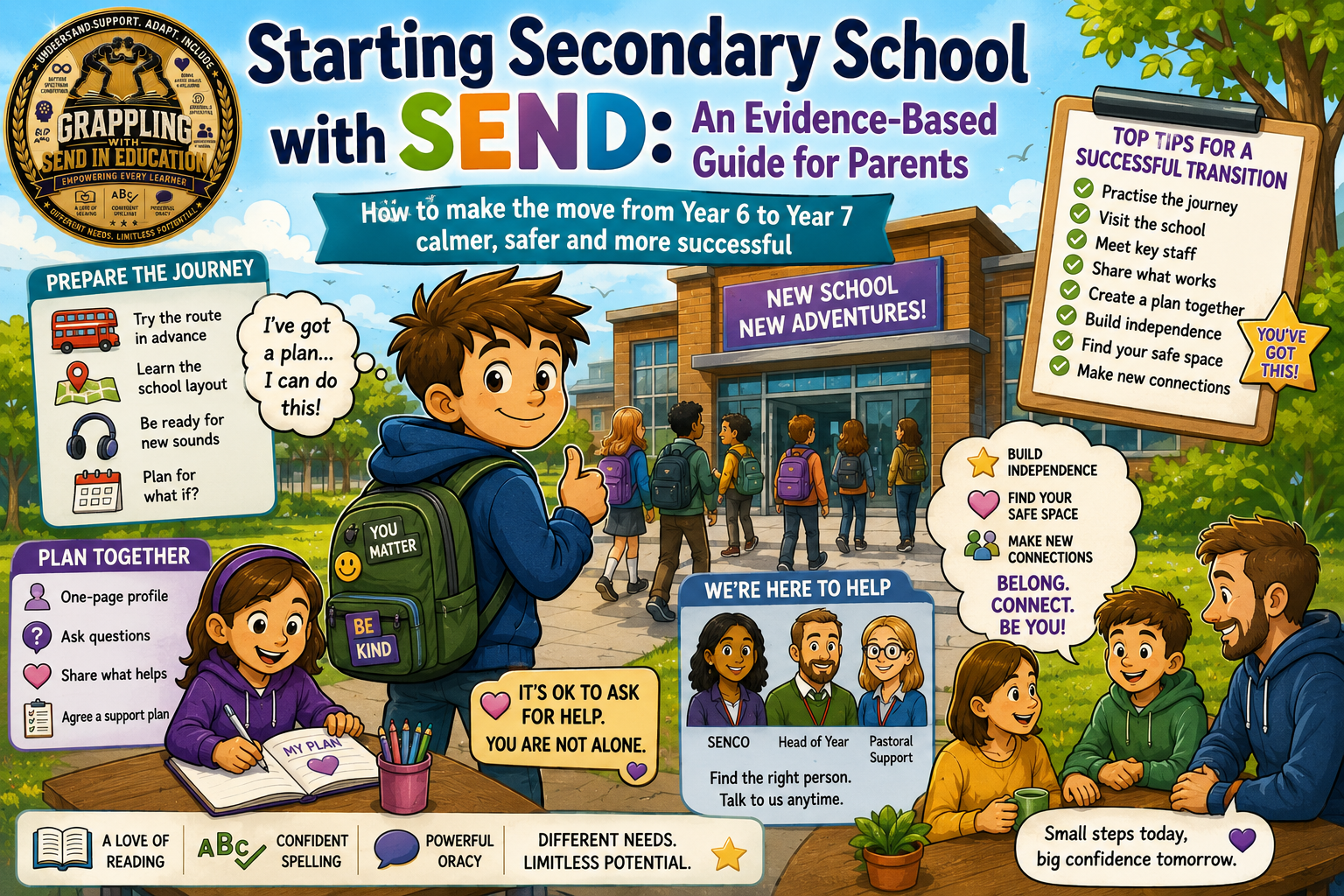
How to make the move from Year 6 to Year 7 calmer, safer and more successful
Starting secondary school is one of the biggest changes of a child’s school life. There is a new building, new teachers, new classmates, different rules, a more complicated timetable and a much greater expectation of independence.
For a child with Special Educational Needs and Disabilities (SEND), these changes can be particularly significant.
The transition from primary to secondary school involves academic, social and organisational challenges, and research suggests that difficulties during this period can affect pupils’ attainment, attitudes towards school and wellbeing (Education Endowment Foundation, 2024; Education Endowment Foundation, 2026).
For pupils with SEND, careful planning is particularly important. The SEND Code of Practice: 0 to 25 Years states that SEN support should include planning and preparation for transitions between phases of education. It also emphasises the importance of sharing information between settings and involving both parents and pupils in deciding what information should be transferred (Department for Education and Department of Health, 2015).
In practical terms, successful transition is therefore about much more than surviving the first morning of Year 7.
It is about preparation, communication, belonging and gradually developing independence.
And there is a great deal that parents can do to help.
Why can secondary school be particularly difficult for children with SEND?
Think about how different a typical secondary-school day is from primary school.
At primary school, a child may spend much of the day in one classroom with one main teacher and a relatively small number of familiar adults. By Year 6, they may know the building, routines and people extremely well.
Secondary school can remove much of that familiarity almost overnight.
A Year 7 pupil may suddenly have to:
- move between numerous classrooms;
- remember different teachers and their expectations;
- follow a timetable independently;
- carry the correct books and equipment;
- navigate busy corridors;
- cope with bells, crowds and noise;
- manage a canteen or unfamiliar lunchtime arrangements;
- organise homework from several subjects;
- negotiate new friendship groups;
- understand different behaviour systems;
- and ask unfamiliar adults for help.
The transition guidance reviewed for this article describes this as effectively “starting again”. Children move from being among the oldest and most experienced pupils in primary school to being the youngest pupils in a much larger and less familiar environment. For pupils with SEND, the challenge may be increased because they encounter numerous teachers who may initially be unfamiliar with their individual needs.
The Education Endowment Foundation similarly identifies adapting to new academic expectations, formal school systems, routines and curriculum differences as important challenges during primary-to-secondary transition (EEF, 2024).
This helps explain why good transition planning needs to look beyond academic ability.
1. Understand what your child is actually worried about
Parents understandably worry about whether their child will cope academically.
Your child may be worrying about something completely different.
Research summarised in the transition literature suggests that children’s concerns frequently focus heavily on the social and organisational aspects of secondary school: making friends, bullying, finding their way around a larger environment and understanding unfamiliar routines.
Their questions may be surprisingly practical:
“Will I get lost?”
“Who will I sit with at lunch?”
“What happens if I forget something?”
“Will I make friends?”
“What if I don’t understand what I’m supposed to do?”
“What happens if I need help?”
This matters because adults can sometimes reassure children about the wrong problem.
Telling a child, “Don’t worry, you’ll cope with the work,” isn’t particularly reassuring if their real concern is having nobody to sit with at lunchtime.
Ask specific questions rather than: “Are you worried about secondary school?”
Try “Which part of the school day feels most confusing at the moment?”
Talk separately about:
- getting to school;
- finding classrooms;
- breaktime;
- lunchtime;
- toilets;
- changing for PE;
- homework;
- making friends;
- getting into trouble;
- asking for help;
- sensory overload;
- forgetting equipment.
This transforms one enormous problem — secondary school — into a series of smaller problems that can often be anticipated and solved.
2. Don’t dismiss anxiety — make the unknown more predictable
It is tempting to respond to an anxious child with something like “There’s nothing to worry about.”
However, practical transition guidance recommends acknowledging that nervousness is a normal response to unfamiliar situations rather than dismissing the feeling. Children may need time to learn new routines, understand the building and establish friendships.
Instead try: “I can understand why that feels worrying. Let’s work out what would make it easier.”
This is particularly relevant for some children with SEND because uncertainty itself can become a significant source of anxiety.
Instead of repeatedly telling the child that everything will be fine, we can try to reduce the number of unknowns.
3. Practise the journey before the first day
Don’t make the first morning of Year 7 the first time your child experiences their journey to secondary school.
Practise it.
If they will walk, walk the route together.
If they will catch a bus, take the bus together.
If there is a particular entrance they need to use, find it.
Practical transition guidance consistently recommends rehearsing the school journey, particularly because secondary pupils may be travelling further and, for the first time, travelling independently or using public transport.
Try practising:
- Home → bus stop → bus → school entrance
- School entrance → bus stop → bus → home
Also rehearse what happens when something goes wrong.
What if the bus doesn’t arrive?
What if you miss your stop?
What if your phone battery dies?
Who could you ask for help?
For a child who finds unexpected situations difficult, knowing the backup plan may be just as important as knowing the normal plan.
4. Make the school familiar before September
For some children with SEND, familiarity can substantially reduce the number of new things they need to process on their first days.
Use whatever the school can provide:
- photographs;
- maps;
- virtual tours;
- transition booklets;
- staff photographs;
- example timetables;
- transition days;
- additional SEND visits.
Visual aids such as photographs, maps and visual timetables are recommended within SEND transition guidance as ways of making a larger and unfamiliar environment more predictable.
Some children may benefit from more detailed preparation.
For example, the guidance reviewed for this article suggests creating a photographic record of the new school and, where appropriate, even a sound map of noises the child may encounter.
For children with sensory differences, that kind of preparation may be particularly useful.
Think beyond classrooms.
Ask to see:
- reception;
- toilets;
- dining hall;
- SEND department;
- playground;
- library;
- changing rooms;
- medical room;
- quiet spaces;
- your child’s form room.
Knowing where to go when something goes wrong may ultimately be more useful than knowing where Geography is.
5. Create a one-page profile
One of the most practical recommendations in the SEND transition guidance is creating a simple one-page profile of your child.
This doesn’t need to read like a medical report.
Instead, it should allow an unfamiliar adult to understand your child quickly.
About me
What does your child enjoy?
What are they good at?
How do they communicate best?
Things I can find difficult
For example:
- unexpected changes;
- crowded corridors;
- handwriting;
- reading instructions;
- processing verbal information;
- loud environments;
- asking for help;
- group work.
Signs I may be struggling
Perhaps your child:
- becomes very quiet;
- talks excessively;
- repeatedly asks the same question;
- becomes restless;
- stops communicating;
- tries to leave;
- becomes upset.
Things that help me
This is perhaps the most important part.
What actually works?
If years of primary education have established that a particular strategy helps your child regulate, organise themselves or understand instructions, their secondary school needs to know about it.
The central question should be:
What is already working, and how much of it can be successfully carried into Year 7?
This approach is consistent with the SEND Code of Practice’s emphasis on schools, parents and pupils working together to identify needs, adjustments, interventions and appropriate support (Department for Education and Department of Health, 2015).
6. Know your SENCO — and know who else to contact
Parents often have less day-to-day contact with secondary school than they did with primary school.
That makes having clear communication channels particularly important.
Before September, establish who your main contact will be.
It might be:
- the SENCO;
- form tutor;
- Head of Year;
- pastoral lead;
- SEND key worker.
Then ask:
How should I contact them?
Email?
Telephone?
School app?
Home-school communication book?
The transition guidance recommends establishing a named contact and agreeing the best method of communication.
The SEND Code of Practice also places considerable emphasis on collaboration between schools, parents and young people when SEN support is being planned and reviewed (Department for Education and Department of Health, 2015).
You don’t want to discover who you need to contact for the first time during a crisis.
7. Ask difficult questions before they become problems
Parents sometimes worry that they are being demanding by asking lots of questions.
Ask them anyway.
The school is familiar to the people working there.
It isn’t familiar to you or your child.
Transition guidance specifically encourages parents to visit the new school, identify possible barriers and ask questions.
Useful questions include:
“Where can my child go if they become overwhelmed?”
“What happens during break and lunchtime?”
“What happens if my child can’t find their classroom?”
“How can they ask for help without drawing attention to themselves?”
“What literacy or numeracy support is available?”
“How will assessment arrangements work?”
“What happens if they forget equipment?”
“How does the school communicate homework?”
“What will Teaching Assistant or Learning Support Assistant support actually look like?”
These questions are reflected directly within the parent transition material reviewed for this article.
8. Understand that secondary-school support may look different
This can surprise families.
A child who received consistent Teaching Assistant support at primary school may not receive support in exactly the same way at secondary school.
Secondary schools may use several Learning Support Assistants across different subjects rather than one adult remaining with a pupil throughout the day. Some schools may also provide nurture spaces, SEND bases, smaller groups or supervised breaktimes.
Different does not automatically mean worse.
But parents should understand what the new model actually looks like.
Rather than simply asking “Will my child receive support?” try “Can you talk me through what their support might look like during an ordinary Monday?”
That is much more likely to produce a meaningful answer.
9. If your child has an EHCP, transition planning matters
For children with an Education, Health and Care Plan (EHCP), transition requires particularly careful forward planning.
The source material emphasises the importance of identifying the new school in sufficient time for staffing, resources, facilities and teaching arrangements to be considered.
The statutory SEND framework similarly requires transition between phases of education to be planned, with relevant information shared between settings (Department for Education and Department of Health, 2015).
Parents should understand:
- what provision is specified;
- how that provision will operate in the new setting;
- who is responsible for coordinating it;
- whether relevant information has transferred from primary school;
- whether relevant staff understand their child’s needs.
Your child’s voice matters too.
The transition material emphasises that by this age children will have developed their own views about how they want to be supported and that these views should be represented within transition planning.
Transition should therefore be something done with the young person, not simply something adults do around them.
10. Consider a multi-agency transition meeting
Where a child has more complex needs, parents can ask whether a transition meeting involving the relevant professionals would be appropriate.
Depending on the child, this might include:
- parents/carers;
- primary SENDCo;
- secondary SENCO;
- class teacher;
- Teaching Assistant;
- educational psychologist;
- speech and language therapist;
- communication and interaction specialists;
- other professionals supporting the child.
The uploaded guidance recommends bringing key adults and agencies together so important information can be transferred between those involved in the child’s education and care.
Bring your one-page profile.
Bring your questions.
And, where appropriate, make sure your child’s views are represented.
11. Teach independence — don’t suddenly demand it
Secondary school requires greater independence.
But independence is a skill to be taught, not something that magically appears because a child has entered Year 7.
This distinction can be particularly important for children with executive-function, attention, memory or organisational difficulties.
The research section of the source material highlights the importance of explicitly developing organisational skills and autonomy as part of transition preparation.
Start small.
Practise:
- packing a school bag;
- checking a timetable;
- remembering PE kit;
- using a planner;
- organising homework;
- getting ready in the morning;
- carrying a bus pass;
- keeping track of keys;
- knowing which equipment belongs to which subject.
Parent transition guidance recommends packing bags the night before and using tools such as colour-coded timetables, homework timetables and equipment lists.
For example:
Monday = Blue
Put a blue dot beside every Monday lesson.
Then create a Monday checklist:
PE kit?
Maths equipment?
Lunch card?
Bus pass?
The aim isn’t to remove support immediately.
It is to scaffold independence and gradually reduce that scaffold when the child is ready.
12. Practise the small things adults forget about
Some of the biggest sources of anxiety can appear surprisingly small to adults.
The transition material recommends preparing children for practical aspects of secondary-school life including canteen systems, planners, uniform rules, equipment and daily routines.
Find out:
- How does your child pay for lunch?
- Card?
- Fingerprint?
- PIN?
- Account?
- Where do they queue?
- When can they use the toilet?
- What happens if they forget their PE kit?
- Where do they refill their water bottle?
- Where do they go if they start their period unexpectedly?
- Are mobile phones permitted?
- Where are lockers?
These things seem obvious once you know them.
Before you know them, they are another uncertainty.
13. Give your child a transition booklet
For children who benefit from visual information, consider creating a small guide they can keep on their phone, in their bag or in their locker.
The source recommends a transition booklet containing photographs of key adults and important rooms.
It could contain:
My form tutor:
Photo + name.
My SENCO:
Photo + name.
If I’m worried, I can go to:
Photo of room.
This is the dining hall:
Photo.
This is where I catch my bus:
Photo.
This is what I do if I get lost:
Simple instructions.
For some children, this provides a useful external memory aid when anxiety makes remembering or processing information more difficult.
14. Belonging matters
One of the important themes identified within transition research is belonging.
Research summarised in the source document, including the School Transition and Adjustment Research Study (STARS), identifies developing a sense of belonging and involvement in secondary-school life as an important element of successful adjustment.
This means parents and schools shouldn’t judge successful transition purely by asking:
“Are they attending every lesson?”
Also ask:
Do they feel that they belong there?
Do they know adults they trust?
Are friendships beginning to develop?
Is there somewhere they feel comfortable at lunchtime?
Are they participating in something they enjoy?
This is why extracurricular activities can be more important than they first appear.
An art club, chess club, football team, drama group, gaming club or library group can provide: a familiar room + a predictable activity + a shared interest + familiar people.
That can help a child begin to develop a place within the school community.
15. Transition doesn’t finish when September begins
This is one of the most important messages for parents.
Schools understandably invest heavily in transition days and activities before pupils arrive.
But transition isn’t finished after Day One.
Research reviewed in the source material highlights the potential value of post-transfer interventions — support that continues after children have actually started secondary school — particularly in developing school belonging.
The Education Endowment Foundation also treats transition as an important educational issue rather than simply a one-day event, identifying potential difficulties involving curriculum continuity, routines, expectations and social relationships (EEF, 2024; EEF, 2026).
Think of transition as lasting throughout the first term and potentially considerably longer.
A child may appear to cope brilliantly for the first week because everything is novel.
Difficulties may emerge later when:
- homework increases;
- initial support reduces;
- friendship groups change;
- tiredness accumulates;
- lessons become harder;
- expectations increase.
Keep communicating.
16. Create low-pressure opportunities to talk
The question: “How was school?” frequently produces: “Fine.”
That tells you very little.
Parent guidance recommends checking in during ordinary activities — perhaps while cooking, travelling or doing something together — rather than making every conversation about wellbeing feel formal or pressured.
Try:
- “What was the easiest part of today?”
- “Which lesson felt longest?”
- “Who did you spend lunchtime with?”
- “Did anything confuse you today?”
- “Who helped you today?”
- “What do you wish you’d known this morning?”
And don’t demand an immediate answer.
Some children need time to process the school day before they are ready to talk about it.
17. Watch for the effort involved in “coping”
A child may appear to cope at school and then struggle once they get home.
Secondary school can require substantial emotional and cognitive energy. Children are simultaneously navigating new friendship groups, unfamiliar expectations and routines while experiencing the developmental changes associated with early adolescence.
The first few weeks may therefore be exhausting.
Some children may temporarily need more:
- quiet;
- food;
- movement;
- familiar activities;
- sensory regulation;
- time alone;
- sleep;
- reduced demands.
Don’t only ask: “Did they manage school?” also consider: “How much effort did managing school require?”
18. Don’t panic about every mistake
Your child will probably forget something.
They may go to the wrong classroom.
They may misunderstand a rule.
They may receive a sanction.
They may lose something.
They may have an awkward friendship moment.
None of these automatically means transition has failed.
Parent guidance emphasises that children need time to adapt and may make mistakes while becoming familiar with their new situation.
Where the same difficulty happens repeatedly, however, look for the barrier behind the behaviour.
If your child repeatedly forgets equipment, perhaps they need an organisational strategy.
If they repeatedly arrive late, perhaps navigating the building is difficult.
If lunchtime behaviour deteriorates, perhaps unstructured time is overwhelming.
If homework isn’t completed, perhaps they cannot independently track work across numerous subjects.
The useful question becomes “What is making this difficult, and what support could make success more likely?”
This is also consistent with the graduated approach within SEND practice: identifying a child’s needs and barriers, planning appropriate support, implementing it and reviewing its effectiveness (Department for Education and Department of Health, 2015).
19. Remember that parents are transitioning too
Parents can find the move difficult.
Primary school may have involved familiar teachers, playground conversations and regular face-to-face contact.
Secondary school can feel much more distant.
Parent transition guidance acknowledges that parents may feel anxious about having less knowledge and control over their child’s new environment. It also reminds parents that children may notice adult anxiety.
You don’t have to pretend everything is wonderful.
But try to communicate confidence that problems can be solved.
Instead of “I have no idea what we’re going to do if this doesn’t work” try “We’ll find out who we need to speak to and work out what needs to happen.”
That communicates something important: Problems are manageable.
A Parent’s SEND Transition Checklist
Before September
- Practise the journey to and from school.
- Visit the school where possible.
- Look at photographs and maps of the site.
- Identify your child’s SENCO.
- Identify another named pastoral contact.
- Create a one-page pupil profile.
- Make sure important information has transferred from primary school.
- Discuss sensory needs and known triggers.
- Ask where your child can go if overwhelmed.
- Find out how break and lunchtime work.
- Find out how the canteen/payment system works.
- Check uniform and mobile-phone policies.
- Practise using the school timetable.
- Create equipment checklists.
- Practise packing the school bag.
- Establish bedtime and morning routines.
- Discuss how your child can ask for help.
- Consider creating a visual transition booklet.
- Ask about clubs connected to your child’s interests.
- If your child has an EHCP, check that transition arrangements and provision are understood.
During September
- Keep after-school demands manageable.
- Check in without interrogating.
- Monitor sleep and exhaustion.
- Ask specifically about break and lunchtime.
- Help organise homework and equipment.
- Maintain communication with your named school contact.
- Notice successes as well as difficulties.
- Encourage friendships and activities that help create belonging.
During the first term
- Gradually reduce organisational support where appropriate.
- Check whether agreed SEND support is actually happening.
- Review strategies that are and aren’t working.
- Ask your child what they think would help.
- Watch for difficulties emerging after the initial settling-in period.
- Contact the school early if concerns persist.
The most important message: prepare for independence, but don’t rush it
Secondary school represents an important move towards independence.
But independence does not mean leaving a child with SEND to struggle until they somehow learn to cope.
Good transition support works differently.
We prepare.
We model.
We practise.
We provide structure.
We gradually remove support when the child is ready.
Research and professional guidance point towards several recurring principles: preparation, communication between home and school, continuity of information, development of organisational skills, opportunities to establish relationships and belonging, and support that continues after the pupil has entered secondary school (Department for Education and Department of Health, 2015; Education Endowment Foundation, 2024; Education Endowment Foundation, 2026).
Parents have something extraordinarily valuable to contribute to that process.
You know your child.
You know what overwhelms them.
You know what motivates them.
You know what successful support looked like at primary school.
Make sure their secondary school benefits from that knowledge.
The objective isn’t to create a September in which nothing goes wrong.
That isn’t realistic for any Year 7 pupil.
The objective is to give your child enough familiarity, support, confidence and trusted relationships that when something does go wrong, they know what to do next.
That is a much more useful definition of a successful transition.
References
- Department for Education and Department of Health (2015) Special educational needs and disability code of practice: 0 to 25 years. London: Department for Education.
- Education Endowment Foundation (2024) Wider strategies: Transition. London: Education Endowment Foundation.
- Education Endowment Foundation (2024) Defying the dip: One school’s approach to supporting pupils’ transition between primary and secondary school. London: Education Endowment Foundation.
- Education Endowment Foundation (2026) Supporting transitions between educational phases to improve pupil outcomes. London: Education Endowment Foundation.
- Merton Transition Working Group and Virtual Behaviour Service (n.d.) Supporting your child with their transition from Year 6 to Year 7. Merton Council.
- YoungMinds (n.d.) Helping your child prepare for secondary or high school. London: YoungMinds.
- Place2Be (n.d.) Helping your child prepare for secondary or high school. London: Place2Be.
- University College London (UCL) (n.d.) School Transition and Adjustment Research Study (STARS). London: UCL.
- Chartered College of Teaching (n.d.) The transition from primary to secondary school: Recommendations from research. London: Chartered College of Teaching.
- The Good Schools Guide (n.d.) Moving on to secondary school: SEND transition guidance. London: The Good Schools Guide.
- Barnsley Council (n.d.) School transitions guidance for children and young people with SEND. Barnsley: Barnsley Metropolitan Borough Council.


Leave a Reply