
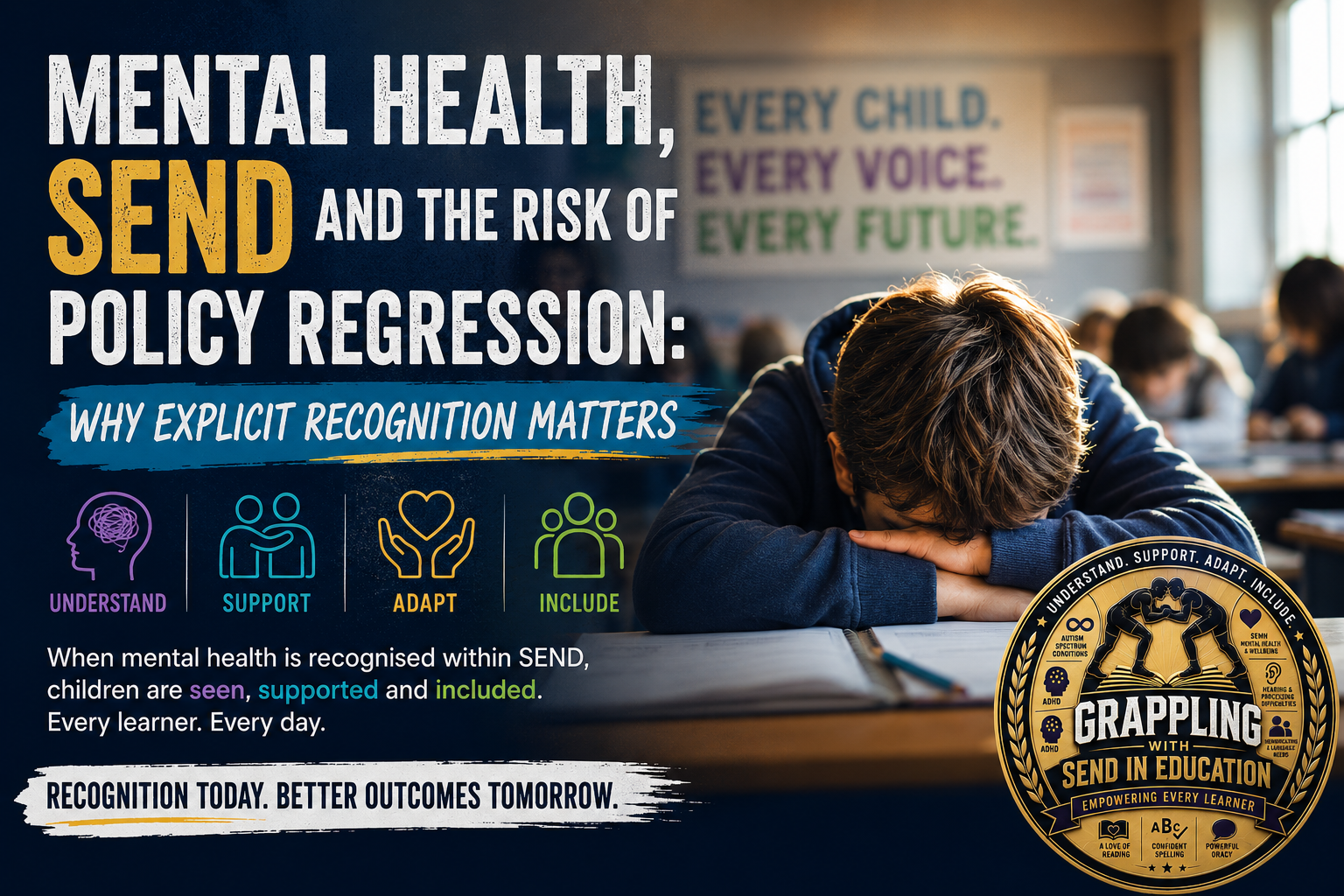
The inclusion of Social, Emotional and Mental Health (SEMH) needs within the 2014 SEND Code of Practice represented one of the most significant developments in English educational policy in recent decades. For the first time, mental health was explicitly recognised as one of the four broad areas of special educational need and disability (SEND), placing emotional wellbeing alongside cognition and learning, communication and interaction, and sensory and physical needs (Department for Education & Department of Health [DfE & DoH], 2015).
At the time, some commentators expressed concern that linking mental health to SEND risked stigmatising children and young people. However, many practitioners viewed the change differently. Rather than creating stigma, the reform legitimised difficulties that schools, families and pupils had long recognised but often struggled to articulate within educational frameworks.
Thomas Keaney (2026) reflects upon this moment, arguing that “for the first time, we were openly acknowledging a truth that schools, families and children already knew: mental health affects children, too.”
The significance of this statement should not be underestimated. It recognised that educational barriers are not solely rooted in literacy, cognition or behaviour. Many pupils struggle to learn because they experience anxiety, trauma, depression, emotional dysregulation, attachment difficulties, social isolation or adverse childhood experiences.
The current SEND reform proposals have therefore generated considerable concern amongst educators, SEND professionals and families. While the government’s commitment to improving inclusion is broadly welcomed, the proposed language appears to move away from explicit recognition of mental health within SEND frameworks.
Keaney warns that “mental health moves from being explicitly embedded within SEND towards something more clinically defined and externally determined.” (Keaney, 2026)
This shift raises fundamental questions about accountability, access to support and the future of inclusion within English schools. This article argues that the explicit recognition of mental health within SEND has delivered significant benefits for pupils, teachers, schools and families. Furthermore, removing or diluting this recognition risks reversing progress, increasing exclusion, widening inequalities and creating greater pressure on already overstretched education and health systems.
The Historical Significance of SEMH Recognition
The 2014 SEND reforms emerged during a period of growing awareness regarding children’s mental health.
Research increasingly demonstrated that mental health difficulties were not rare occurrences affecting a small minority of children. Instead, emotional wellbeing was recognised as a major factor influencing educational achievement, attendance, behaviour, social development and long-term life outcomes (Public Health England, 2021).
The introduction of SEMH represented a fundamental shift in educational thinking.
Previously, children displaying anxiety, emotional distress or challenging behaviour were often viewed through behavioural or disciplinary lenses. Difficulties were interpreted as poor motivation, non-compliance or inadequate parenting. The SEMH category encouraged schools to look beyond surface behaviours and consider underlying needs.
As Keaney explains, “it normalised conversations about mental health and wellbeing, and recognised that barriers to learning are not always academic or behavioural in origin.”
This recognition aligned with emerging trauma-informed approaches that encouraged educators to ask “What has happened to this child?” rather than: “What is wrong with this child?” (Bomber, 2020). The result was a gradual movement towards more compassionate, evidence-informed educational practice.
The Positive Impact on SEND Pupils
The greatest beneficiaries of SEMH recognition have arguably been pupils themselves. Many SEND learners experience mental health difficulties at significantly higher rates than their peers. Research consistently demonstrates elevated levels of anxiety amongst autistic children, increased rates of depression among adolescents with learning difficulties, and greater vulnerability to emotional dysregulation amongst pupils with ADHD (NICE, 2022). These relationships are not coincidental.
Many SEND learners experience:
- Social exclusion.
- Bullying.
- Academic frustration.
- Sensory overload.
- Communication barriers.
- Low self-esteem.
- Difficulties forming friendships.
Each factor increases vulnerability to mental health difficulties. Recognition of SEMH enabled schools to address these interconnected needs holistically. Instead of separating educational difficulties from emotional wellbeing, schools could acknowledge that both frequently coexist. For example, an autistic pupil refusing to attend school might previously have been viewed as truanting or displaying oppositional behaviour. Under SEMH frameworks, staff became more likely to explore:
- Anxiety.
- Sensory overload.
- Social exhaustion.
- Unmet communication needs.
- Trauma arising from repeated failure.
This shift often resulted in more appropriate interventions and better outcomes.
The Positive Impact on Teachers
The introduction of SEMH also transformed professional understanding. Teachers increasingly recognised that learning cannot be separated from emotional wellbeing. Educational neuroscience has repeatedly demonstrated that chronic stress impairs attention, memory formation, executive functioning and self-regulation (Shonkoff et al., 2012).
Consequently, children experiencing significant emotional distress often struggle academically regardless of instructional quality. The SEMH framework provided teachers with professional language to discuss these challenges.
Keaney (2026) states “once mental health was recognised within SEND, it became harder to ignore.” This recognition empowered teachers to advocate for support. Rather than framing difficulties as behavioural problems, teachers could identify educational needs requiring intervention. The result included:
- Increased referrals.
- Earlier identification.
- Improved pastoral support.
- Greater collaboration with SENCOs.
- More effective multi-agency working.
Importantly, teachers gained permission to consider emotional wellbeing as part of their educational responsibility.
The Positive Impact on Schools
Schools themselves also benefited from SEMH recognition. Many schools developed:
- Nurture provision.
- Emotional literacy programmes.
- Counselling services.
- Mental health support teams.
- Therapeutic interventions.
- Family liaison programmes.
Keaney observes that SEMH opened “the door to therapeutic thinking, mental health practitioners and more joined-up conversations between education and health.”
These developments contributed to broader cultural change. Mental health became part of safeguarding discussions, attendance strategies, behaviour policies and SEND provision maps. Increasingly, schools recognised that inclusion required more than keeping pupils physically present in classrooms. True inclusion demanded understanding and responding to emotional need.
The Positive Impact on Families
Families frequently report that obtaining recognition of emotional and mental health needs can be difficult. Many parents spend years attempting to convince professionals that their child’s difficulties are real. The SEMH framework provided legitimacy – I t reassured families that emotional difficulties affecting learning were not simply parenting failures or behavioural issues. For many parents, the SEND framework offered:
- Access to assessments.
- Multi-agency support.
- Educational adjustments.
- Greater understanding from schools.
Importantly, it reduced blame. Parents were more likely to encounter professionals asking: “How can we help?” rather than Why is your child behaving this way?”
The Emerging Shift in Policy
The proposed reforms do not remove social and emotional development entirely. However, they appear to reposition mental health within health services rather than educational systems. Keaney identifies this as a significant concern. Under current proposals:
“The proposed reforms replace SEMH with ‘social and emotional’ need.”
At first glance, this ma y appear insignificant. However, language shapes accountability. When mental health is explicitly recognised within SEND, educational systems retain responsibility for responding. When mental health becomes primarily a clinical matter, responsibility risks shifting elsewhere. The question becomes:
Who supports children whose mental health affects learning but who do not meet NHS thresholds?
The Risk of Pupils Falling Between Systems
This is perhaps the greatest danger. Many children experience significant distress without receiving formal mental health diagnoses. These pupils may:
- Attend irregularly.
- Experience panic attacks.
- Withdraw socially.
- Self-harm.
- Present challenging behaviour.
- Struggle academically.
Yet they often fail to meet thresholds for specialist intervention. Keaney the question “if mental health is no longer clearly located within SEND, who becomes responsible when a child’s distress affects education but does not meet increasingly stretched NHS thresholds?”
This concern reflects current realities. CAMHS services remain under significant pressure. Waiting lists continue to grow. Thresholds continue to rise. Without explicit educational responsibility, many children risk receiving no meaningful support.
The Impact on Autistic Pupils
Autistic children may be particularly affected. Research (Cassidy et al., 2018) demonstrates that autistic individuals experience significantly elevated rates of:
- Anxiety disorders.
- Depression.
- School avoidance.
- Suicidal ideation.
For many autistic pupils, mental health difficulties arise directly from experiences within educational environments. Sensory overload, social exclusion and repeated misunderstanding contribute significantly to distress.
Removing explicit mental health recognition risks fragmenting support. Schools may focus on autism. Health services may focus on mental health. Neither may address the interaction between the two.
The Impact on Pupils with ADHD
Children with ADHD are similarly vulnerable (Barkley, 2015). Research suggests they are significantly more likely to experience:
- Anxiety.
- Depression.
- Low self-esteem.
- Emotional dysregulation.
Many ADHD-related difficulties overlap with SEMH concerns. Without integrated approaches, support risks becoming fragmented and inconsistent.
The Impact on Exclusions and Attendance
One of the most concerning consequences may involve exclusion. Nationally, pupils identified with SEND remain disproportionately represented within exclusion statistics. Many excluded pupils demonstrate unmet SEMH needs. If mental health becomes less visible within SEND frameworks, schools may become more likely to interpret distress as misconduct.
Keaney warns that “non-exclusion is not achieved through aspiration alone.”
This observation is particularly important. Inclusion requires resources. Without therapeutic support, schools may struggle to sustain placements for pupils presenting complex needs.
Teacher Workload and Burnout
The proposed reforms may also increase pressure on teachers. Schools are already responding to rising levels of:
- Anxiety.
- Self-harm.
- Emotional dysregulation.
- School refusal.
- Social isolation.
If mental health is repositioned outside SEND while specialist services remain inaccessible, responsibility will not disappear. Instead, responsibility will remain with schools but without clear frameworks, resources or accountability structures. This creates conditions for professional burnout. Teachers cannot simultaneously deliver high-quality teaching, therapeutic support, safeguarding interventions and family crisis management without adequate resources.
The Future for Schools
The long-term implications are concerning. If support becomes increasingly difficult to access:
- EHCP requests may increase.
- SEND tribunals may rise.
- Parent-school conflict may worsen.
- Alternative provision demand may grow.
- Attendance difficulties may escalate.
- Exclusions may increase.
Schools may find themselves expected to become more inclusive while receiving fewer mechanisms through which inclusion can be achieved. Keaney states “if we ask schools not to exclude but fail to provide the resources needed to support complexity, inclusion becomes rhetoric rather than reality.”
The Wider Societal Consequences
The consequences extend beyond education. Children whose mental health needs remain unmet are at greater risk of:
- Unemployment.
- Social exclusion.
- Criminal justice involvement.
- Family breakdown.
- Long-term mental illness.
Keaney highlights concerns regarding vulnerable pupils at risk of “inpatient care, family breakdown or the secure estate.” Failure to intervene early rarely reduces costs. Instead, it transfers them elsewhere.
The Potential Impact on Education, Health and Care Plans (EHCPs)
One of the least discussed consequences of removing explicit mental health recognition from SEND frameworks may be its impact on Education, Health and Care Plans (EHCPs).
The Children and Families Act (2014) established EHCPs as integrated plans designed to coordinate support across education, health and social care. In theory, the framework recognises that children do not experience their needs in separate categories. Educational difficulties, health concerns and family circumstances often interact in complex ways.
Mental health has increasingly become a central factor within EHCP applications. Many families seek statutory assessment because emotional distress, anxiety, school refusal or emotional dysregulation have become significant barriers to educational participation.
The challenge is that mental health difficulties often sit at the intersection of educational and clinical need.
For example:
- An autistic pupil may experience severe anxiety.
- A child with ADHD may develop depression following repeated academic failure.
- A young person with speech and language difficulties may experience social isolation and emotional distress.
- A pupil with learning difficulties may develop school-based trauma following years of perceived failure.
Under current arrangements, these interconnected difficulties can be considered holistically within SEND processes. However, if mental health becomes increasingly positioned outside SEND frameworks, new questions emerge:
- Which agency assumes responsibility?
- How are educational impacts evidenced?
- Who coordinates provision?
- How are disagreements resolved?
There is a risk that parents may increasingly seek EHCPs as the only mechanism capable of securing support.
Ironically, reforms designed to reduce pressure on the system could generate greater demand for statutory protection. This phenomenon has already been observed in previous SEND reforms. As local services become harder to access through universal or targeted provision, families often seek legally enforceable plans because they represent one of the few guaranteed routes to support. Consequently, removing explicit recognition of mental health from SEND may unintentionally accelerate EHCP requests rather than reduce them.
The Likely Growth in SEND Tribunals
An increase in EHCP requests inevitably raises another concern: SEND tribunals. The SEND Tribunal system has experienced substantial growth over the past decade. Success rates for parents consistently exceed 90%, suggesting that many families pursue appeals because they believe existing systems have failed to identify or meet their child’s needs.
When policy language becomes ambiguous, disputes often increase. The current SEND Code of Practice provides relatively clear recognition of SEMH needs. Parents, schools and local authorities may disagree about provision, but they largely operate from a shared understanding that mental health can constitute a SEND need. If this clarity disappears, disagreements are likely to increase. Local authorities may argue that difficulties represent health needs. Health services may argue that thresholds have not been met. Schools may argue that they lack the resources to intervene. Parents may find themselves trapped between systems. Such circumstances are precisely the conditions that generate tribunal appeals. Rather than simplifying SEND processes, policy changes may therefore increase administrative burden and legal challenge.
Attendance and the School Refusal Crisis
Any discussion of mental health within education must acknowledge the growing attendance crisis. Persistent absence and emotionally based school avoidance have become major concerns across England. Government data consistently demonstrates links between attendance, attainment and future life chances.
However, attendance discussions frequently overlook the role of mental health. Many children are not absent because they reject education. They are absent because school has become psychologically overwhelming. Anxiety, panic disorders, trauma, sensory difficulties and social fears increasingly contribute to school non-attendance. This issue is particularly significant for SEND learners.
Autistic pupils, children with ADHD and young people with SEMH needs are disproportionately represented amongst persistently absent pupils. Recognition of mental health within SEND frameworks has enabled many schools to develop supportive attendance strategies focused on:
- Emotional regulation.
- Safe spaces.
- Gradual reintegration.
- Family support.
- Therapeutic intervention.
If mental health becomes less visible within SEND policy, attendance difficulties risk being reframed as compliance issues rather than indicators of need. This would represent a significant regression. Punitive attendance approaches rarely resolve emotionally based school avoidance because they fail to address underlying causes. Indeed, they may exacerbate distress and further damage relationships between schools and families.
Exclusion, Behaviour and Mental Health
One of the most significant achievements of SEMH recognition has been its contribution to changing how schools understand behaviour. Historically, challenging behaviour was often interpreted through disciplinary frameworks. Children who struggled to regulate emotions were frequently viewed as disruptive, defiant or poorly behaved.
Contemporary research paints a more complex picture. Many behaviours reflect attempts to communicate distress. Anxiety may appear as avoidance. Trauma may appear as aggression. Depression may appear as disengagement. Autistic overwhelm may appear as refusal.
The SEMH framework encouraged schools to explore these possibilities. It promoted the idea that behaviour should be understood within context. Removing explicit mental health recognition risks undermining this progress. The danger is not necessarily that schools become less compassionate. Rather, it is that policy signals influence practice.
When mental health is less visible within SEND frameworks, behavioural explanations may regain prominence. This could contribute to increased:
- Suspensions.
- Permanent exclusions.
- Managed moves.
- Alternative provision placements.
Such outcomes are particularly concerning given the overrepresentation of SEND learners within exclusion statistics.
The Impact on Children with Autism
Few groups illustrate the interconnected nature of SEND and mental health more clearly than autistic pupils. Research consistently demonstrates elevated rates of:
- Anxiety disorders.
- Depression.
- Self-harm.
- Suicidal ideation.
- School avoidance.
Many of these difficulties emerge not because autism itself causes mental illness but because autistic individuals frequently encounter environments that fail to meet their needs. School can be exhausting.
Sensory overload, social uncertainty, communication barriers and masking behaviours create significant psychological strain. When mental health is recognised within SEND frameworks, schools are encouraged to consider these interactions. Support can be designed around the whole child rather than isolated diagnoses.
Removing explicit mental health recognition risks fragmenting this approach. Schools may address autism. Health services may address anxiety. Neither may adequately address the relationship between the two.
The Impact on Children with ADHD
Children with ADHD face similar challenges. ADHD is increasingly understood as involving substantial emotional regulation difficulties.
Many pupils experience:
- Rejection-sensitive dysphoria.
- Chronic frustration.
- Low self-esteem.
- Anxiety.
- Depression.
Repeated experiences of criticism, punishment and academic difficulty can profoundly affect mental wellbeing. The SEMH framework has allowed many schools to recognise these broader impacts. A purely behavioural interpretation of ADHD often focuses on compliance. A SEMH-informed perspective focuses on understanding. This distinction matters because support strategies differ dramatically depending upon which perspective is adopted.
The Impact on Pupils with Speech, Language and Communication Needs
Speech, language and communication needs (SLCN) are often overlooked in discussions of mental health. Yet communication difficulties can significantly affect emotional wellbeing. Children who struggle to express feelings frequently experience:
- Social isolation.
- Frustration.
- Misunderstanding.
- Low self-confidence.
Mental health difficulties may therefore emerge as secondary consequences of communication barriers. If educational systems separate emotional wellbeing from SEND provision, opportunities for early intervention may be lost. Instead of addressing root causes, services may focus on symptoms once difficulties become severe.
The Risk of Increased Inequality
A further concern involves educational inequality. Affluent families often possess greater capacity to navigate complex systems. They may:
- Access private assessments.
- Obtain legal representation.
- Fund independent therapy.
- Challenge decisions through tribunals.
Disadvantaged families typically face greater barriers. When systems become fragmented, inequality often increases. Children from disadvantaged backgrounds are therefore most likely to suffer if mental health support becomes dependent upon navigating multiple disconnected services. This raises important questions regarding social justice. SEND policy should reduce inequalities rather than amplify them.
Long-Term Societal Consequences
The implications extend far beyond schools. Mental health difficulties that remain unsupported during childhood frequently continue into adulthood. Research links childhood emotional difficulties with:
- Lower educational attainment.
- Reduced employment opportunities.
- Poor physical health.
- Increased mental illness.
- Greater involvement with social care.
- Higher rates of criminal justice contact.
Keaney (2026) highlights concerns regarding vulnerable young people whose needs place them at risk of:
“inpatient care, family breakdown or the secure estate.” (Keaney, 2026)
This observation reflects a broader reality. Failure to intervene early rarely eliminates costs. Instead, costs reappear elsewhere. Education saves money. Early intervention saves money. Therapeutic support saves money. The question is therefore not whether society pays, but when and where. Removing explicit mental health recognition from SEND risks shifting costs into healthcare, social care and criminal justice systems. Such an approach may prove both economically and morally unsustainable.
Where Could These Reforms Lead in the Future?
If current trends continue unchecked, several outcomes appear increasingly plausible. Firstly, schools may become more inclusive in principle but less able to sustain inclusion in practice. Secondly, EHCP demand may continue rising as families seek legally enforceable support. Thirdly, tribunal appeals may increase due to disputes regarding responsibility. Fourthly, attendance difficulties may worsen. Fifthly, exclusions may rise among the most vulnerable pupils. Finally, mental health support may become increasingly crisis-driven rather than preventative.
This would represent a profound contradiction.
The original purpose of recognising SEMH within SEND was to identify need early and intervene before difficulties escalated. Future reforms should strengthen that principle rather than weaken it. The challenge facing policymakers is not whether children’s mental health affects education. The evidence overwhelmingly demonstrates that it does. The real question is whether educational policy will continue to acknowledge this reality or retreat towards a model in which mental health becomes someone else’s responsibility. History suggests that when responsibility becomes everyone’s, it often becomes no one’s.
Recommendations for Policymakers
- Retain explicit recognition of mental health within SEND.
- Strengthen rather than weaken SEMH pathways.
- Improve CAMHS capacity and reduce waiting times.
- Increase funding for school-based therapeutic services.
- Expand Educational Psychology provision.
- Strengthen multi-agency accountability frameworks.
- Improve SEND workforce training around mental health.
- Ensure reforms are evaluated against inclusion outcomes.
Recommendations for Schools
Schools should:
- Continue trauma-informed practice.
- Embed mental health within SEND provision.
- Strengthen pastoral systems.
- Invest in staff training.
- Develop family partnerships.
- Improve attendance support.
- Monitor vulnerable pupils proactively.
Most importantly, schools must resist any tendency to separate mental health from educational participation. Learning and wellbeing remain inseparable.
Conclusion
The inclusion of SEMH within the 2014 SEND Code of Practice represented a landmark moment in English education. It legitimised children’s mental health needs, empowered teachers, supported families and encouraged more inclusive practice. As Keaney (2026) argues, these reforms helped to normalise conversations about mental health and created opportunities for more therapeutic and humane approaches to support.
The danger within current reform proposals is not that mental health disappears entirely, but that responsibility becomes blurred. When mental health moves from explicit educational recognition towards externally determined clinical thresholds, vulnerable children risk falling between systems.
The fundamental challenge remains unchanged. Children do not experience their educational, emotional and mental health needs separately. Schools, families and policymakers should not attempt to address them separately either.
As Keaney concludes: “Renaming need does not remove need.” The future success of SEND reform may ultimately depend upon whether policymakers remember this simple truth.
References
- Barkley, R. A. (2015). Attention-Deficit Hyperactivity Disorder: A Handbook for Diagnosis and Treatment (4th ed.). Guilford Press.
- Bomber, L. M. (2020). Know Me to Teach Me. Worth Publishing.
- Cassidy, S., Bradley, L., Shaw, R., & Baron-Cohen, S. (2018). Risk markers for suicidality in autistic adults. Molecular Autism, 9(42), 1–14.
- Department for Education & Department of Health. (2015). Special Educational Needs and Disability Code of Practice: 0–25 Years.
- Keaney, T. (2026). SEND: The Mental Health Shift in Policy Plans is Worrying.
- National Institute for Health and Care Excellence. (2022). Mental Wellbeing in Children and Young People.
- Public Health England. (2021). Promoting Children and Young People’s Emotional Health and Wellbeing.
- Shonkoff, J. P., Garner, A. S., Siegel, B. S., et al. (2012). The lifelong effects of early childhood adversity and toxic stress. Pediatrics, 129(1), e232–e246.


Leave a Reply