Literacy remains one of the most significant determinants of educational achievement, social mobility, and long-term life opportunities. The ability to read and spell proficiently is fundamental not only to academic success but also to participation in wider society. Reading allows individuals to access knowledge, communicate effectively, and engage critically with the world around them, while spelling supports written communication, confidence, and cognitive development. The Organisation for Economic Co-operation and Development (OECD, 2019) identifies literacy as a key factor influencing educational attainment, employability, and social inclusion. Similarly, Hirsch (2003) argues that literacy is intrinsically connected to cultural capital and empowerment, enabling individuals to fully participate in civic and social life. Consequently, children who experience difficulties with reading and spelling are at a considerable disadvantage, both within education and beyond it.
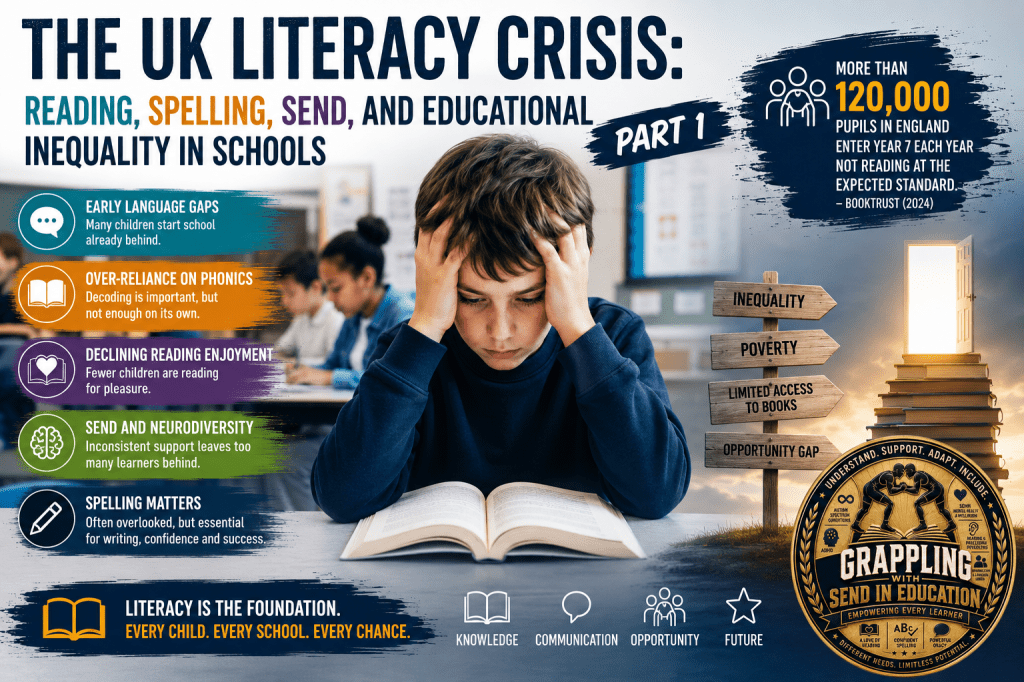
Despite decades of educational reform, intervention programmes, and literacy initiatives, substantial literacy gaps continue to exist across the United Kingdom and internationally. Research consistently demonstrates that a significant proportion of children fail to meet expected standards in reading and writing by the time they reach secondary education. According to BookTrust (2024), over 120,000 pupils in England enter Year 7 each year without achieving the expected standard in reading. This statistic highlights the persistence of literacy difficulties despite increased policy attention and investment in early reading instruction. Such difficulties are often cumulative, with early weaknesses in literacy development leading to long-term barriers in accessing the wider curriculum.
The challenges surrounding literacy acquisition are complex and multifaceted. One of the most significant contributing factors is the presence of early language deficits. Oral language development forms the foundation of literacy acquisition, and children who enter school with limited vocabulary, reduced language exposure, or delayed communication skills frequently struggle to develop reading fluency and comprehension (Education Endowment Foundation [EEF], 2021). The COVID-19 pandemic further intensified these concerns, with many children experiencing disrupted early education, reduced social interaction, and fewer opportunities for language-rich experiences. As a result, schools have increasingly reported significant gaps in vocabulary knowledge, speech development, and reading readiness among younger learners.
In recent years, phonics-based instruction has become a dominant approach to teaching reading within primary education in England. While systematic synthetic phonics has been shown to improve early decoding skills, critics argue that an over-reliance on phonics can lead to a narrow understanding of literacy development. The Full Reading and Spelling Study (2024) suggests that many schools place substantial emphasis on phonics intervention while neglecting other essential aspects of reading, such as comprehension, fluency, vocabulary acquisition, and reading enjoyment. Reading is a highly complex cognitive process that extends beyond the ability to decode words accurately. Skilled readers must also interpret meaning, infer information, and engage critically with texts. Consequently, an exclusive focus on phonics may fail to support learners who require broader literacy interventions.
Another growing concern within literacy education is the decline in reading enjoyment among children and young people. Reading for pleasure has been strongly associated with improved academic attainment, vocabulary development, empathy, and mental wellbeing (Clark & Teravainen-Goff, 2020). However, many children report reading less frequently outside school, often due to increased screen time, digital distractions, and reduced access to books within the home environment. The National Literacy Trust (2023) found that levels of reading enjoyment among children in the UK have reached some of the lowest levels recorded in recent years. This decline is particularly concerning because motivation and engagement play a central role in developing reading stamina and fluency. Children who do not enjoy reading are less likely to practise it regularly, thereby widening existing literacy gaps.
Neurodiverse learners, including pupils with autism spectrum condition (ASC), attention deficit hyperactivity disorder (ADHD), dyslexia, and speech and language difficulties, often face additional barriers to literacy development. While inclusive education policies have improved awareness of special educational needs and disabilities (SEND), provision remains inconsistent across schools. The Full Reading and Spelling Study (2024) highlights that many literacy interventions are not sufficiently adapted to meet the needs of neurodiverse learners. For example, some pupils may struggle with phonological processing, working memory, sensory regulation, or language comprehension, all of which can significantly affect reading and spelling acquisition. Without adaptive teaching strategies and personalised intervention, these learners may experience repeated failure, leading to reduced confidence, anxiety, and disengagement from education.
Spelling, despite being a fundamental component of literacy, is frequently overlooked within modern literacy instruction. Educational discourse often prioritises reading outcomes while placing less emphasis on spelling development. However, spelling is essential for written communication, vocabulary retention, and academic achievement. According to the EEF (2021), effective spelling instruction should include explicit teaching of morphology, etymology, and orthographic patterns alongside phonics. Many pupils, particularly those with dyslexia and other learning difficulties, require structured and cumulative spelling instruction over an extended period. Nevertheless, spelling interventions in schools are often inconsistent, fragmented, or limited due to curriculum pressures and time constraints.
Socioeconomic inequality also continues to play a major role in literacy attainment. Children from disadvantaged backgrounds are statistically more likely to experience literacy difficulties due to reduced access to books, limited literacy experiences at home, and economic barriers affecting educational opportunities (OECD, 2019). These inequalities often emerge before children begin formal schooling and can widen significantly over time if not addressed through targeted intervention and support. Schools serving disadvantaged communities frequently face additional challenges, including limited funding, high levels of SEND, and increased pastoral demands.
In conclusion, literacy development remains one of the most pressing educational challenges facing schools today. Reading and spelling are not merely academic skills but essential tools for communication, social participation, and lifelong learning. Although substantial progress has been made in understanding literacy acquisition, significant gaps persist due to early language deficits, over-reliance on narrow instructional approaches, declining reading engagement, inconsistent SEND provision, and socioeconomic inequality. Addressing these issues requires a comprehensive and inclusive approach that recognises the complexity of literacy development and prioritises adaptive teaching, reading enjoyment, language development, and targeted support for vulnerable learners. Only through sustained and evidence-informed practice can schools hope to reduce literacy inequities and ensure that all children are equipped with the skills necessary to succeed academically and socially.
References
BookTrust. (2024). Reading and literacy statistics in the UK. Available at: BookTrust
Clark, C., & Teravainen-Goff, A. (2020). Reading for pleasure and its impact on children’s literacy development. National Literacy Trust.
Education Endowment Foundation (EEF). (2021). Improving Literacy in Key Stage 1 and Key Stage 2. London: EEF.
Hirsch, E. D. (2003). Reading comprehension requires knowledge of words and the world. American Educator, 27(1), 10–13.
National Literacy Trust. (2023). Children and young people’s reading engagement report. London: National Literacy Trust.
OECD. (2019). PISA 2018 Results: What Students Know and Can Do. Paris: OECD Publishing.
The Full Reading and Spelling Study. (2024). Findings on literacy barriers and educational inequality.
 Grappling with SEND in Education
Leave a comment